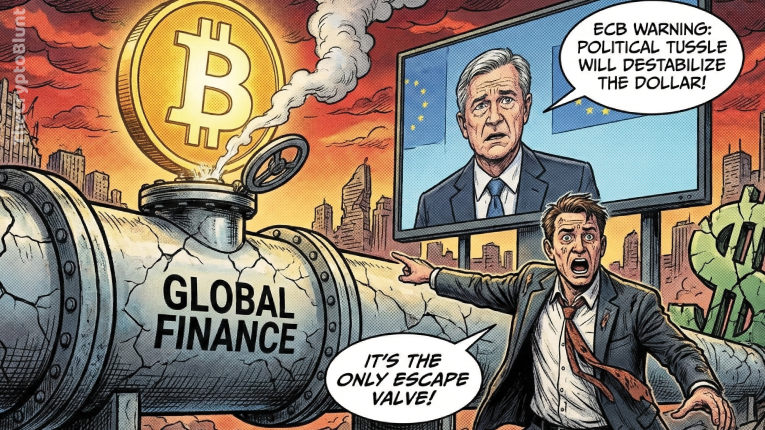
A credibility shock that can lift long yields while the dollar weakens is flagged by Lane, an observation that splits Bitcoin’s path into two distinct regimes.
A warning that most markets treated as European housekeeping was delivered by European Central Bank chief economist Philip Lane: the ECB can stay on its easing path for now, but global markets could be destabilized by a Federal Reserve “tussle” over mandate independence through higher US term premiums and a reassessment of the dollar’s role.
The exact transmission channels that matter most to Bitcoin are named by Lane’s framing, which highlights real yields, dollar liquidity, and the credibility scaffolding that holds the current macro regime together.
The immediate catalyst for cooling was geopolitical. Oil’s risk premium was seen to fade as fears of a US strike on Iran receded, pulling Brent to around $63.55 and West Texas Intermediate to roughly $59.64 as of press time, a correction of approximately 4.5% since the Jan. 14 peak.
The pipeline from geopolitics to inflation expectations to bonds was defused by that shift, at least temporarily.
However, a different kind of risk was pointed to by Lane’s comments: not supply shocks or growth data, but the possibility that political pressure on the Fed could force markets to reprice US assets on governance grounds rather than fundamentals.
Fed independence has been flagged as critical by the IMF in recent weeks, noting that erosion would be “credit negative.” This is the kind of institutional risk that shows up in term premiums and foreign-exchange risk premiums before it shows up in headlines.
Term premiums are defined as the portion of long-term yields that compensate investors for uncertainty and duration risk, separate from expected future short rates.
As of mid-January, the New York Fed’s ACM term premium was positioned around 0.70%, while FRED’s 10-year zero-coupon estimate registered roughly 0.59%. The 10-year Treasury nominal yield stood at approximately 4.15% on Jan. 14, with the 10-year TIPS real yield at 1.86% and the five-year breakeven inflation expectation at 2.36% on Jan. 15.
These are stable readings by recent standards, but the point is made by Lane that stability can vanish quickly if markets begin pricing a governance discount into US assets. A term-premium shock doesn’t require a Fed rate hike, as it can happen when credibility erodes, pulling long-end yields higher even as the policy rate stays put.
When the Term Premium Becomes the Discount-Rate Channel
Bitcoin is operated within the same discount-rate universe as equities and duration-sensitive assets.
When term premiums rise, long-end yields climb, financial conditions tighten, and liquidity premiums compress. The manner in which dollar appreciation follows Fed tightenings across multiple policy dimensions has been documented by ECB research, making US rates the world’s pricing kernel.
Bitcoin’s historical upside torque comes from expanding liquidity premiums: when real yields are low, discount rates are loose, and risk appetite is characterized by high levels.
That dynamic is reversed by a term-premium shock without the Fed changing the federal funds rate, which is why Lane’s framing matters for crypto even though he was addressing European policymakers.
The dollar index sat at roughly 99.29 on Jan. 16, near the lower end of its recent range. However, two distinct scenarios, rather than one, are opened by Lane’s phrase “reassessment of the dollar’s role.”
In the classic yield-differential regime, the dollar is strengthened by higher US yields, which tighten global liquidity and pressure risk assets, including Bitcoin. Research shows that crypto has become more correlated with macro assets post-2020 and, in some samples, exhibits a negative relationship with the dollar index.
In a credibility-risk regime, the outcome is bifurcated: term premiums can rise even as the dollar weakens or chops if a governance risk discount is demanded by investors on US assets. In that scenario, Bitcoin can trade more like an escape valve or an alternative monetary asset, especially if inflation expectations rise alongside credibility concerns.
Additionally, a tighter linkage to equities, artificial intelligence narratives, and Fed signals is exhibited by Bitcoin now than in earlier cycles.
A reversal to net inflows was experienced by Bitcoin ETFs, with a total exceeding $1.6 billion in January per Farside Investors data. It was further noted by Coin Metrics that a clustering of spot options open interest occurred at $100,000 strikes leading into late-January expiries.
That positioning structure means macro shocks can get amplified through leverage and gamma dynamics, turning Lane’s abstract “term premium” concern into a concrete catalyst for volatility that is felt by the entire market.
How Stablecoin Infrastructure Turns Dollar Risk Crypto-Native
A large share of crypto‘s transactional layer is run on dollar-denominated stablecoins backed by safe assets, often Treasuries.
Stablecoins are connected to safe-asset pricing dynamics by Bank for International Settlements research, meaning a term-premium shock isn’t just “macro vibes.” It can feed into stablecoin yields, demand, and on-chain liquidity conditions.
The cost of holding duration is increased by rising term premiums, which can ripple through stablecoin reserve management and alter the liquidity available for risk trades. Bitcoin may not be a direct Treasury substitute, but it lives in an ecosystem where Treasury pricing sets the baseline for what “risk-free” means.
Approximately 97.2% probability is currently assigned by markets to the Fed holding rates steady at its January meeting, and expected rate cuts have been pushed later into 2026 by major banks.
Confidence in near-term policy continuity is reflected by that consensus, which keeps term premiums anchored. But Lane’s warning is forward-looking: if that confidence breaks, term premiums can jump by 25 to 75 basis points over the course of weeks without any change in the funds rate.
A mechanical example: if term premiums rose 50 basis points while expected short rates stayed flat, the 10-year nominal yield could be drifted from around 4.15% toward 4.65%, and real yields would reprice higher in tandem.
Tighter conditions and downside risk would be faced by Bitcoin through the same channel that pressures high-duration equities.
A different risk profile is created by the alternative scenario of a credibility shock that weakens the dollar.
If global investors diversify away from US assets on governance grounds, the dollar could be weakened even as term premiums rise, and Bitcoin’s volatility would spike in either direction depending on whether the yield-differential regime or the credibility-risk regime dominates.
Bitcoin’s inflation-hedge properties are debated by academic work, but the dominant channel in most risk regimes remains real yields and liquidity, not breakeven inflation expectations alone.
Both possibilities are forced onto the table by Lane’s framing, which is why “dollar repricing” isn’t a single directional bet, but a fork in the regime.
Key Developments to Watch
A straightforward approach is taken by the checklist for tracking this story.
On the macro side, term premiums, 10-year TIPS real yields, five-year breakeven inflation expectations, and the dollar index level and volatility are monitored.
On the crypto side, spot Bitcoin ETF flows, options positioning around key strikes like $100,000, and skew changes into macro events are tracked.
The dots between Lane’s warning and Bitcoin’s price action are connected by these indicators without requiring speculation about future Fed policy decisions.
European markets were primarily targeted by Lane’s message, but the pipes he described are the same ones that determine Bitcoin’s macro environment. The oil premium faded, but the governance risk he flagged hasn’t.
If a Fed tussle is begun to be priced by markets, the shock won’t stay US-local. It will transmit through the dollar and the yield curve, and Bitcoin will register the impact before most traditional assets do.