The Crypto Blunt
  • All News
  • Bitcoin
  • Ethereum
  • Altcoin
  • Market
  • Blockchain
  • AI
  • More
    • About Us
    • Contact
Reading: Vitalik Proposes “Garbage Collection” to Curb Ethereum Bloat
Share
The Crypto BluntThe Crypto Blunt
Font ResizerAa
  • All News
  • Bitcoin
  • Ethereum
  • Altcoin
  • Market
  • Blockchain
  • AI
  • More
Search
  • Pages
    • Contact Us
    • Search Page
    • 404 Page
  • Pages
    • Home
    • Contact Us
    • Search Page
    • 404 Page
  • Pages
    • Home
    • Contact Us
    • Search Page
    • 404 Page
  • Personalized
    • Read History
  • Personalized
    • Read History
  • Personalized
    • Read History
  • Categories
    • Technology
  • Categories
    • Technology
  • Categories
    • Technology
Have an existing account? Sign In
Follow US
  • Pages
  • Pages
  • Pages
  • Personalized
  • Personalized
  • Personalized
  • Categories
  • Categories
  • Categories

Home - News - Vitalik Proposes “Garbage Collection” to Curb Ethereum Bloat

News

Vitalik Proposes “Garbage Collection” to Curb Ethereum Bloat

Hardik Z.
Last updated: January 19, 2026 6:50 am
Hardik Z. - Chief in Editor & Writer
Published: January 19, 2026
Share
Vitalik Proposes “Garbage Collection” to Curb Ethereum Bloat

Protocol complexity is being inflated by Ethereum’s push to add new features while preserving backward compatibility, according to a warning from Vitalik Buterin, who is calling for a “garbage collection” process.

Contents
  • Buterin Calls for “Garbage Collection” to Tackle Ethereum Bloat
  • Solana Labs CEO Favors an Alternative Approach

Developers are being urged by Ethereum co-founder Vitalik Buterin to confront the protocol bloat driven by an endless push to add new features while rarely removing old ones.

A Sunday post on X was used by Buterin to argue that true trustlessness and self-sovereignty depend less on raw decentralization metrics and more on simplicity.

“Even if a protocol is super decentralized with hundreds of thousands of nodes, and it has 49% byzantine fault tolerance, and nodes fully verify everything with quantum-safe peerdas and starks, if the protocol is an unwieldy mess of hundreds of thousands of lines of code and five forms of PhD-level cryptography, ultimately that protocol fails,”

he claimed

According to Buterin, Ethereum’s three primary pillars are undermined by this complexity. First, trustlessness is weakened by forcing users to rely on “high priests” to explain what the protocol actually does. Second, it fails the so-called walkaway test, because rebuilding high-quality clients becomes unrealistic if existing teams disappear. Third, it erodes self-sovereignty, as even highly technical users can no longer inspect or reason about the system on their own.

Buterin Calls for “Garbage Collection” to Tackle Ethereum Bloat

Buterin warned that the issue is rooted in how protocol changes are evaluated. When upgrades are judged mainly by how disruptive they are to existing systems, decision-making is tended to be dominated by backward compatibility. The result is a bias toward additions rather than subtractions, causing the protocol to grow heavier over time.

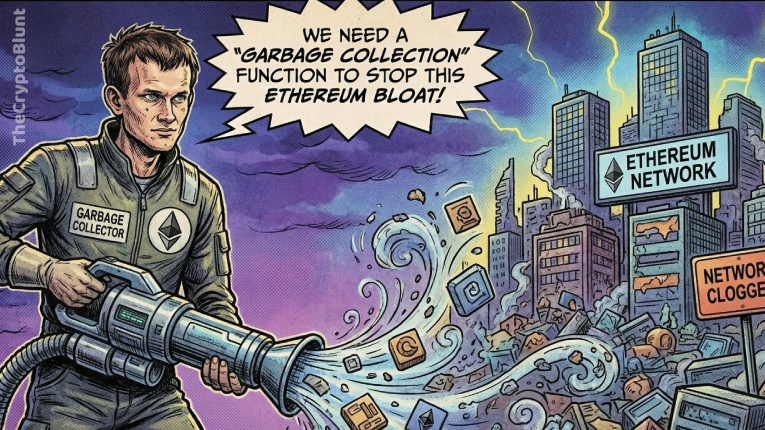
An explicit “simplification” or “garbage collection” function in Ethereum’s development process was called for by Buterin to counter this trend. The goal would be to reduce total lines of code, limit reliance on complex cryptographic primitives, and introduce more invariants — fixed rules that make client behavior easier to predict and implement.

Past transitions were pointed to by the Ethereum co-founder as examples of effective cleanup. The shift from proof-of-work (PoW) to proof-of-stake (PoS) was one large-scale reset, while more recent efforts, such as gas cost reforms, aim to replace arbitrary rules with clearer links to actual resource usage. Future cleanups could involve demoting rarely used features from the core protocol into smart contracts, reducing the burden on client developers.

Solana Labs CEO Favors an Alternative Approach

Constant motion must be maintained by Solana, according to Solana Labs CEO Anatoly Yakovenko, who argues that a blockchain that stops evolving to meet developer and user needs risks becoming irrelevant. Responding to a recent post by Buterin, Yakovenko claimed that continuous iteration is essential for Solana’s survival, even if no single group is responsible for driving those changes.

In contrast, it has been argued by Buterin that Ethereum should eventually pass the “walkaway test,” reaching a point where it can operate securely and predictably for decades without ongoing developer intervention.


TAGGED:EthereumVitalik Buterin

Sign Up For Daily Newsletter

Be keep up! Get the latest breaking news delivered straight to your inbox.
By signing up, you agree to our Terms of Use and acknowledge the data practices in our Privacy Policy. You may unsubscribe at any time.
Share This Article
Facebook Email Copy Link Print
ByHardik Z.
Chief in Editor & Writer
Follow:
Hardik Z. is a cryptocurrency expert, trader and well-researched journalist with extensive experience of covering everything related to the burgeoning industry — from price analysis to Blockchain disruption. Hardik authored more than 1,000+ stories for Thecryptoblunt.com, and other fintech media outlets. He’s particularly interested in web3, crypto trends, regulatory trends around the globe that are shaping the future of digital assets, can be contacted at hardik.z@thecryptoblunt.com
Previous Article ECB Warns of Dollar Instability as Bitcoin Emerges as a Potential Escape Valve ECB Warns of Dollar Instability as Bitcoin Emerges as a Potential Escape Valve
Next Article Coinbase CEO Pushes Back on Claims White House Dropped CLARITY Act Support Coinbase CEO Pushes Back on Claims White House Dropped CLARITY Act Support
Leave a Comment

Leave a Reply Cancel reply

Your email address will not be published. Required fields are marked *

FacebookLike
XFollow
InstagramFollow
LinkedInFollow
MediumFollow
RSS FeedFollow
The Crypto BluntLogo
Subscribe to our newsletter to get our newest articles instantly!
Most Read
DraftKings Uses CFTC Framework to Roll Out Predictions Marketplace App

DraftKings Uses CFTC Framework to Roll Out Predictions Marketplace App

What is Bonk?

What is Bonk (BONK)? What It Is, Overview, Works, Guides, Everything You Need to Know

What is BNB?

What is BNB? What It Is, Overview, Works, Guides, Everything You Need to Know

What is Bittensor? 

What is Bittensor (TAO)? What It Is, Overview, Works, Guides, Everything You Need to Know

What is Bitget Token?

What is Bitget Token (BGB)? What It Is, Overview, Works, Guides, Everything You Need to Know

What is Bitcoin Cash? 

What is Bitcoin Cash (BCH)? What It Is, Overview, Works, Guides, Everything You Need to Know

What is Avalanche(AVAX)?

What is Avalanche(AVAX)? What It Is, Overview, Works, Guides, Everything You Need to Know

What is Arbitrum? 

What is Arbitrum(ARB)? What It Is, Overview, Works, Guides, Everything You Need to Know

Aptos

What is Aptos(APT)? What It Is, Overview, Works, Guides, Everything You Need to Know

What is Aave (AAVE)? What It Is, Overview, Works, Guides, Everything You Need to Know

What is Aave (AAVE)? What It Is, Overview, Works, Guides, Everything You Need to Know

thecryptoblunt-telegram
Logo

The most recent real-time news about crypto at Thecryptoblunt. Latest trusted news about bitcoin, ethereum, blockchain, mining, cryptocurrency prices and more.

NEWS
  • Explained
  • News
  • AI
  • Blockchain
COMPANY
  • About Us
  • Career
GET IN TOUCH
  • Contact
  • Terms & conditions
  • Privacy Policy
  • Consent Settings
  • Disclaimer
  • Cookie Policy
  • Editorial policy
  • RSS

© The Crypto Blunt 2025. All Rights Reserved.

© The Crypto Blunt. All Rights Reserved.
Go to mobile version
Welcome Back!

Sign in to your account

Username or Email Address
Password

Lost your password?