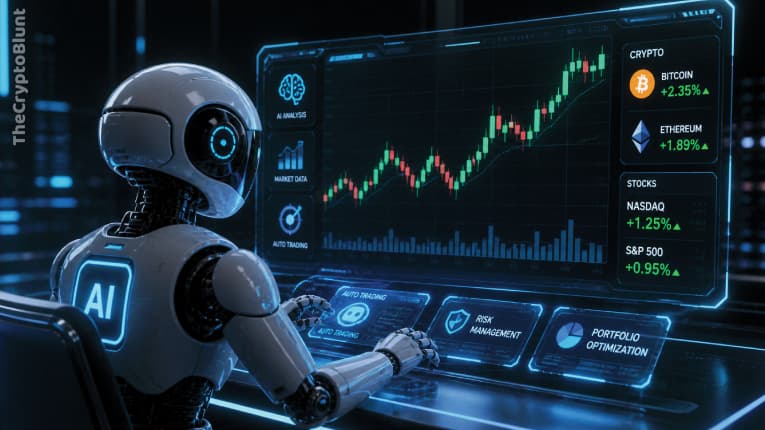
The trading floor of 2026 looks nothing like it did a decade ago. Where human intuition and manual order entry once ruled, sophisticated AI-powered bots now execute strategies in milliseconds, process terabytes of live data in real time, and operate without sleep, emotion, or hesitation. From Wall Street’s institutional desks to individual retail accounts on crypto exchanges, the adoption of AI trading bots is no longer a frontier experiment — it is the new baseline of competitive market participation. The numbers behind this transformation are staggering, and the structural implications for both crypto and equity markets are only beginning to unfold.
The Market Explosion: Numbers That Define the Era#
The scale of this shift is best understood through market size data. The global algorithmic trading market, valued at $28.47 billion in 2025, is projected to reach $32.77 billion in 2026 and expand to $99.74 billion by 2035, reflecting a 13.16% compound annual growth rate over the forecast period.
This is not a niche sector quietly growing in the background — it is one of the fastest-expanding segments in global financial technology. Algorithmic trading now accounts for approximately 70% of U.S. stock trading volumes, with over 80% of financial institutions having adopted AI to some extent, while the global AI trading market is projected to reach $826.70 billion by 2030 at a CAGR of 36.6%.
These figures underscore a fundamental structural shift: AI-driven execution is no longer the exclusive domain of elite hedge funds. The retail investors segment is estimated to contribute the highest market share of 38.5% in the algorithmic trading market in 2026, owing to increased accessibility of algorithmic trading platforms. Technology has democratized the algorithm, and retail traders are now deploying the same tools that were once reserved for quantitative funds.
Why AI Bots Are Winning: The Core Drivers#
1. Speed and Execution Precision Beyond Human Limits#
The most fundamental advantage of AI trading bots is pure execution speed. Industry data indicates that in high-volatility environments, manual trading is increasingly constrained by the speed of data processing and execution, making AI trading bots and algorithmic trading systems essential tools for modern investors. In a market where a price can move 2% in under a second, milliseconds are the difference between profit and loss.
2. The 24/7 Crypto Advantage#
Unlike stock markets with defined trading hours, crypto markets never close. Crypto markets run 24/7, stock markets move quickly during active sessions, and most traders cannot monitor every signal manually — a useful AI crypto or stock trading bot can help scan markets, follow preset rules, execute trades, manage alerts, or support backtesting. This structural reality makes AI bots not just convenient in crypto — they are practically essential.
3. Institutional-Grade Tools Entering Every Tier#
The biggest players are accelerating investment. In November 2025, Citadel Securities committed $300 million to GPU-accelerated execution algorithms in partnership with NVIDIA, aiming to reduce transaction costs by 15%, while JPMorgan Chase introduced a quantum-inspired optimization module on its Fusion platform in September 2025, reducing portfolio-construction runtimes by 20%. These institutional commitments signal that AI trading infrastructure is entering a new performance era — and the technology is trickling down to retail-accessible platforms rapidly.
4. Sentiment Analysis and Alternative Data Processing#
Goldman Sachs uses AI to process unstructured data — including news, social media, and earnings reports — alongside traditional market data, with this fusion of information feeding into trading algorithms that allow the firm to execute more informed trades at unprecedented scale and speed. This multi-source intelligence approach is now being replicated by retail-facing platforms, giving individual traders access to news-driven, sentiment-adjusted strategies that were once the exclusive preserve of billion-dollar trading desks.
New Platform Launches: The 2026 Wave#
April 30, 2026 marked a notable industry development. AriseAlpha announced the expansion of its automated investing platform, introducing a strategy-driven AI trading system designed to support both cryptocurrency and stock market participation within a single unified platform, with the convergence of AI crypto trading and AI stock trading reflecting a broader shift toward unified investing environments.
Stay in the loop
Get crypto news before the market moves
Join thousands of investors who read our daily briefing.
No spam. Unsubscribe anytime.
This cross-market integration is a defining trend of 2026. The ability to deploy a single AI strategy across both BTC futures and NASDAQ equities simultaneously represents a new frontier in portfolio automation — one that manual trading simply cannot replicate at scale.
The Bond Market Joins the Revolution#
AI adoption is no longer limited to equity and crypto markets. Nearly 85% of firms plan to increase AI use in corporate bond trading over the next year, up sharply from 57% in 2024 — a surge that signals a pivotal shift toward an AI-powered bond market where advanced analytics and machine learning promise to uncover hidden liquidity and lower transaction costs. When even the traditionally conservative fixed-income world is embracing algorithmic execution at this pace, it confirms that AI trading is no longer a trend — it is a structural transformation of global finance.
The Downside: Real Risks That Cannot Be Ignored#
The AI trading revolution is not without serious risk vectors. These are the bearish elements every participant must understand:
Flash Crash Amplification: When volatility spikes, many algorithms withdraw quotes simultaneously, creating liquidity vacuums that deepen price swings and expose firms to execution slippage and regulatory scrutiny. The 2026 version of a flash crash would be an AI-driven event — a cascade of algorithmic withdrawals creating a feedback loop no human could stop in time.
Strategy Underperformance in Black Swan Events: Unpredictable market conditions can lead to strategy underperformance of over 25% during high-stress periods, as models calibrated on historical data struggle with unprecedented events — while evolving compliance requirements can increase related overhead by up to 35% as firms implement robust real-time monitoring systems.
Regulatory Pressure Intensifying: The forthcoming Colorado AI Act, expected to go into effect in 2026, requires much greater transparency from AI trading systems, mandating that companies demonstrate that black-box models are not being used, while the EU is expanding its Explainable AI requirements to force algorithms to disclose their decision-making processes to regulators and stakeholders. Non-compliant platforms face operational risk that could affect execution quality and user access.
Technical Summary Scorecard#
| Factor | Status | Signal |
|---|---|---|
| Global Market Size 2026 | $32.77B | ✅ Explosive Growth |
| U.S. Stock Volume (AI-driven) | ~70% | ✅ Dominant |
| Retail Trader Adoption | 38.5% Market Share | ✅ Democratizing |
| Citadel GPU Investment | $300M | ✅ Institutional Bullish |
| Bond Market AI Adoption | 85% Planning Increase | ✅ Expanding |
| Flash Crash Risk | Liquidity Vacuum Threat | 🔴 Systemic Risk |
| Strategy Underperformance | 25%+ in Stress Events | 🔴 Model Risk |
| Regulatory Overhead | Up to 35% Cost Increase | 🔴 Compliance Headwind |
Conclusion: The Algorithm Has the Edge — For Now#
AI trading bots in 2026 represent the most significant transformation in market microstructure since the introduction of electronic trading. The speed, scale, consistency, and accessibility advantages are real and measurable. But so are the systemic risks — flash crashes, model failures, and regulatory exposure are structural vulnerabilities that no amount of optimization has fully solved. For traders and institutions alike, the strategic imperative is clear: adopt, adapt, and manage risk with the same sophistication the algorithms themselves are designed to apply. In the AI trading era, the edge goes to those who understand both the power and the limits of the machine.