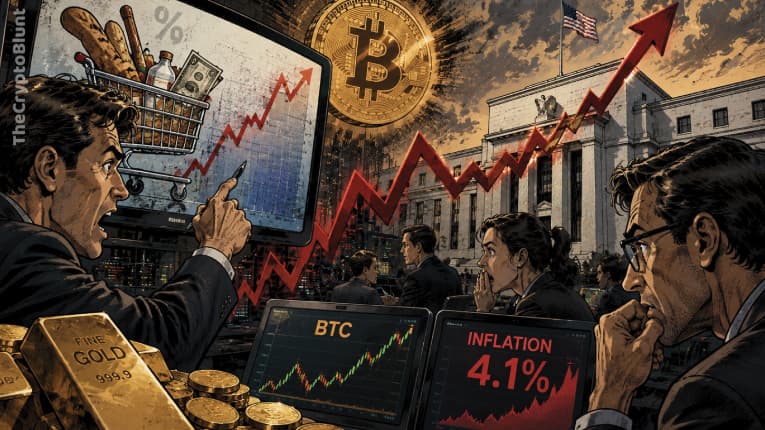
Markus Thielen of 10x Research said the firm still considers the broader macroeconomic backdrop to be a challenge for Bitcoin’s performance.
Market observers have warned that Bitcoin and gold could encounter additional pressure in the months ahead after US Consumer Price Index (CPI) data released on Wednesday showed annual inflation rising 4.2% in May.
The sharp increase in the Consumer Price Index, a widely followed measure of prices for goods and services throughout the US economy, weakened expectations for interest-rate cuts by the Federal Reserve. Some analysts now anticipate additional rate increases later this year, a development that could weigh on higher-risk investments such as cryptocurrencies.
Bitcoin has already endured a difficult start to the year, with its price declining 36% since January. Gold has also retreated, falling 23% from the high reached at the beginning of the year. In contrast, crude oil prices have climbed by more than 50% during the same period.
“Today’s in-line CPI print keeps the Fed cautious, data-dependent, and in no rush to cut,” Iggy Ioppe, chief investment officer at institutional trading firm Theo, told .
The Consumer Price Index (CPI) measures how the cost of a representative basket of consumer goods and services changes over time. Policymakers at the Federal Reserve closely monitor the indicator, and it remains one of the most important data points used in shaping monetary policy decisions.
He added that an inflation reading in line with expectations is unlikely to provide a decisive trigger for Bitcoin in either direction. Such an outcome would keep hopes for additional liquidity restrained, while risk-sensitive assets would continue to be influenced more by market positioning than by any new dovish signal from policymakers.
Ioppe also noted that gold continues to face downside pressure. He explained that real yields remain the primary factor influencing the market, and without near-term interest rate cuts, the opportunity cost associated with holding a non-yield-bearing asset remains relatively high.
Institutions Show No Major Shift Toward Bitcoin Allocations#
Markus Thielen, head of research at 10x Research, told that he believes the broader macroeconomic backdrop continues to create challenges for Bitcoin and remains a significant obstacle to stronger price momentum.
Stay in the loop
Get crypto news before the market moves
Join thousands of investors who read our daily briefing.
No spam. Unsubscribe anytime.
“We do not believe this data is sufficiently encouraging to prompt Wall Street investors to meaningfully reallocate into Bitcoin,” he said.
“Institutional investors will likely want to see further evidence that inflation is moving sustainably lower before increasing exposure. At the same time, the escalating conflict involving Iran introduces additional uncertainty, particularly given the risk of ongoing oil supply disruptions.”
Thielen forecast that these market disruptions may intensify during the summer period, potentially becoming more noticeable and adding fresh upward pressure to inflation expectations in the months ahead.
He said Bitcoin continues to face downside risks and remains exposed to further weakness. In his view, the chances of the cryptocurrency falling below the $60,000 level are growing, with such a move becoming increasingly probable in the days ahead.
Risk Appetite Unlikely to Return Until Inflation Eases#
Tim Sun, a senior researcher at HashKey Group, said expectations for additional interest rate increases are gaining momentum. However, he noted that the likelihood of the Federal Reserve actually raising rates before the end of the year remains comparatively low.
“Only when inflation drops, rate cuts become viable, and liquidity improves alongside lower capital costs, will the overall risk appetite truly reverse.”
Data from CME futures markets indicates a 98.4% likelihood that the Federal Reserve will leave interest rates unchanged at its upcoming policy meeting scheduled for June 17.