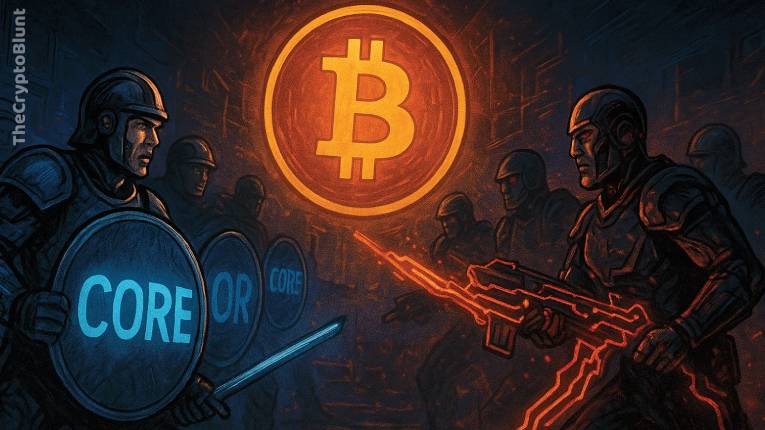
A total public node count of 23,163 is reported for Bitcoin, with 18,850 utilizing Bitcoin Core and 4,265 operating Bitcoin Knots—a figure that places Knots at 18.41%. This comes as a week-long discourse on X highlights whether the network should rely on fee incentives alone or allow stricter relay policies to limit non-monetary data.
The ‘Money First’ vs. ‘Neutral Ledger’ Debate Divides Bitcoin Community
Over 174 distinct X posts from Aug. 27 to Sept. 3, the disagreement was centered by BTC supporters on a core principle: Is Bitcoin a fundamentally monetary network whose impartiality demands the relay of all valid transactions, or should node operators prefer software that filters certain patterns at the mempool and relay layers to deter large, non-monetary payloads?
Over the last week, a consistent argument has been made by supporters of Knots that more stringent default policies are a pragmatic safeguard, not an alteration to consensus. They emphasize that both clients validate blocks containing inscriptions and other valid transactions. Their contention is that Knots provides more configurable policy “knobs” and defaults to tighter data-carrier rules, allowing operators to reduce the bandwidth and storage burden from non-monetary data while still validating legitimate blocks.
Proponents of Core have rebutted that the protocol’s purpose is neutrality: if a transaction is consensus-compliant and the fee market dictates the price of block space, then relay filters impose subjective judgments at the network layer. From this viewpoint, fee competition—not application-level heuristics—is the intended allocator of scarce block space; hard-coding content biases threatens network fragmentation and establishes a precedent for gatekeeping.
A prominent assertion in Knots-friendly X posts was the claim that easing relay limits (often framed around OP_RETURN payload size) could enable the storage of arbitrarily large files. This would make node operation costlier and, in extreme hypotheticals cited by many X accounts, raise reputational and legal concerns if offensive content were pushed through mempools. Several posts contended that filters are a type of “hygiene,” meant to keep nodes focused on monetary data.
Both the effectiveness and the necessity of such filters were challenged by responses from the Core camp. One line of argument stated that relay filters are ineffective at diminishing what miners include in blocks and therefore do little to facilitate historical synchronization or stop data from reaching the chain. The fee dynamics, they added, are sufficient to make non-financial stuffing expensive. This camp generally viewed policy filtering as redundant and potentially ideological.
The money-versus-data argument was a frequent topic throughout the week. Supporters of Knots stated that Bitcoin should prioritize monetary transactions, comparing broad data relay to transforming nodes into personal file servers for anonymous uploaders. They framed the choice of client as a referendum on Bitcoin’s scope: money first, or a universal data ledger. Detractors countered that Bitcoin does not stipulate “monetary” at the script level; transactions are just structures validated by consensus rules.
It was repeatedly highlighted by proponents of neutrality that both Core and Knots validate consensus-compliant blocks, including those with inscriptions. They argued that treating mempool policy as a stand-in for consensus can confuse users about what a node enforces. In this framing, switching clients does not remove data from the chain; it merely modifies what a node relays or displays.
Some posters raised the disagreement to a matter of governance and network legitimacy. A faction argued that Knots is indicative of a “network-first” ethos—where developers propose software, but nodes decide; if Core ships changes that are rejected, the network wins. Others accused both sides of infusing philosophy into tooling, but the majority of posts were sorted along the neutrality-versus-filtering axis.
The disagreement was shown to reflect deeper questions about how Bitcoin evolves as client diversity becomes more apparent. With both Core and Knots providing valid avenues for operators, the debate hints at a broader test: whether differing policies strengthen resilience by offering choice, or whether diverging defaults could splinter perceptions of what it means to run a “neutral” Bitcoin node.
The intense discussions also demonstrate how cultural narratives influence technical choices. Advocates didn’t simply evaluate bandwidth expenses or block space effectiveness; they referenced identity, governance, and enduring confidence in the network. This indicates future conflicts may expand beyond programming into legitimacy concerns, where the equilibrium between neutrality and judgment will be shaped by Bitcoin’s development as significantly as protocol enhancements.