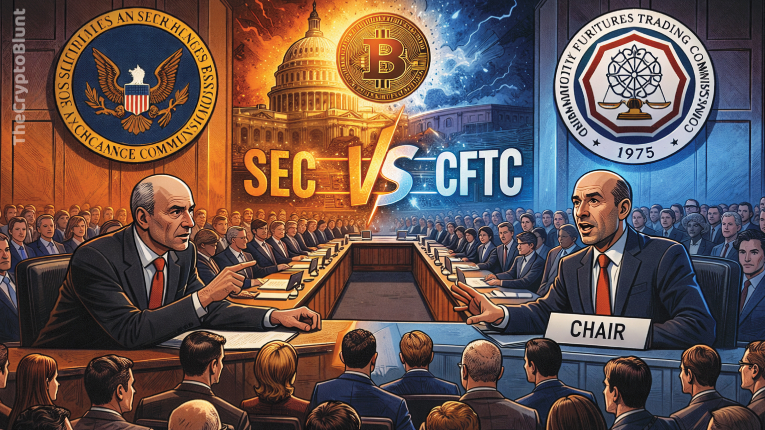
CFTC recently appointed executives from Coinbase, Ripple, Uniswap, Solana, and Chainlink as selected representatives to its advisory board—herein lies the rationale.
CFTC Forms New Innovation Advisory Committee With Leaders From Crypto and Prediction Markets
The majority of Crypto speculators rarely consider the Commodity Futures Trading Commission until a system failure occurs, a legal filing is impacted by their strategy, or a BTC derivative announcement traverses their newsfeed.
In the common conceptual framework of American oversight, the SEC maintains its gaze on digital tokens, whereas the CFTC manifests primarily alongside Bitcoin, typically when derivative contracts are overseen.
Subsequently, the Commodity Futures Trading Commission executed a maneuver that contradicts that crafted narrative.
On February 12, the commission unveiled a revised roster for its Innovation Advisory Committee, a 35-member assembly detailed as a prestigious directory of blockchain pioneers, traditional financial infrastructure giants, and the emerging sector of forecast exchanges.
Prominent figures instantly command attention: Coinbase’s Brian Armstrong, Robinhood’s Vlad Tenev, and Polymarket’s Shayne Coplan, alongside Hayden Adams of Uniswap, Ripple’s Brad Garlinghouse, Solana Labs’ Anatoly Yakovenko, Chainlink’s Sergey Nazarov, and Kraken co-CEO Arjun Sethi, who all appear cataloged within the identical government bulletin.
The scope expands significantly. This assembly, comprised of influential figures, also integrates executives from the fundamental engines of American commerce: Nasdaq, CME Group, Intercontinental Exchange, DTCC, Options Clearing Corporation, and ISDA.
Consequently, the genuine inquiry avoids ‘why digital asset executives counsel the capital,’ as that phenomenon has manifested through various iterations for decades. The curiosity focuses on why the CFTC constructs a forum this expansive, this diverse, and this blockchain-saturated during a period when many observers still perceive the regulator as exclusively associated with the Bitcoin niche.
The explanation originates with the CFTC’s mandate as the arbitrator for derivative exchanges, then cascades into a grander arena: a conflict over forecast marketplaces and a legislative drive within Congress that could grant the commission a more substantial portion of blockchain governance than many observers currently anticipate.
A Committee Reflecting the Future Direction of Capital Flows
The commission’s internal rhetoric regarding the assembly emphasizes structural evolution and institutional resilience, spearheaded by newly appointed chairman Michael Selig. The participant roster reveals the remaining narrative.
Aligning Coinbase and Robinhood alongside CME and Nasdaq yields a visualization of the digital asset sector’s forthcoming era—one that appears positioned less toward viral speculation and more toward systemic architecture.
Settlement, safekeeping, margin management, oversight, instrument drafting, trade transparency, and the mundane protocols governed by regulators determine the ultimate viability of a financial offering.
That constitutes the segment most individual participants never witness, until a gateway halts, an offering vanishes, or an official is classified as a trade-altering mandate. The IAC remains populated by the architects who construct those conduits—both decentralized pathways and legacy systems.
The roster further encompasses the chief executives of Kalshi and Polymarket, while integrating FanDuel and DraftKings figureheads into the identical cohort. One might view this as a peculiarity, or perceive it as the commission tacitly signaling that outcome-based derivatives are categorized as essential components of the forthcoming financial architecture.
This significance stems from the transition of forecast exchanges from obscure digital hobbies into phenomena where general audiences are confronted by them during athletic events, elections, and entertainment trends, while prominent news organizations already monitor the perplexity this generates for both civilians and oversight bodies.
CFTC Invites Crypto Executives Into Policy Discussions
Dual trajectories are intersecting here, and both forces serve to orient the CFTC toward digital assets, even if a personal conceptual framework remains exclusively propelled by Bitcoin.
Initially, legislators are currently weighing whether the commission should possess augmented jurisdiction over ‘digital commodities.’ The Senate Agriculture Committee recently progressed the Digital Commodity Intermediaries Act, which they portrayed as a move toward establishing CFTC governance and bolstering investor safeguards. Should this trajectory persist, the agency’s cryptographic mandate will evolve from a specialized market segment to a vastly more significant territorial domain.
Furthermore, the commission has signaled an increasingly proactive stance regarding the integration of emerging technology within market protocols. In a recent collaborative release between the CFTC and SEC, interagency alignment regarding physical commodity products and platform versatility was emphasized as part of an extensive campaign to revolutionize the administration of these marketplaces.
Consider a practical reality: Individual experts develop the framework, and those professionals must comprehend how assets react during volatility, how order books aggregate, where fraud manifests, and which structural elements collapse first. These guidelines are formulated by the very minds who grasp the underlying system mechanics.
A consultation board populated with chief executives offers one method to accelerate that educational transition. Bloomberg Law portrayed this development as the new chairperson’s intensifying dependency on blockchain, forecast market, and exchange specialists through a cohort of high-profile consultants.
One might dispute whether such a shift appears beneficial, hazardous, or merely unavoidable. This movement can also be interpreted as a clear indicator: the commission readies itself for a landscape where digital assets mirror conventional financial instruments, while traditional offerings begin assimilating cryptographic functions, including tokenized margins, perpetual trading cycles, and automated finality.
Prediction Markets Push the Debate to the Forefront
To discover the most direct route to grasping why Polymarket and Kalshi occupy seats within this assembly, scrutinize the capital flows and monitor the ongoing jurisdictional conflict. The core motivation is located within the intersection of financial incentives and regulatory dominance.
Forecast marketplaces have demonstrated staggering turnover figures recently. The Block manages a monthly index auditing Polymarket and Kalshi activity, providing a transparent metric for the velocity at which this sector expands. These metrics are recorded to illustrate the unprecedented scaling of the industry.
The expansion has transitioned into a cultural phenomenon. Reports from The Guardian indicate that Kalshi recorded a $1 billion daily turnover peak during the 2026 Super Bowl, while noting that these venues have captured the interest of individuals who previously never associated their activities with ‘trading.’ This influx represents a massive shift in public engagement.
Simultaneously, the jurisdictional and statutory perimeter remains contested. The commission’s leader has openly discussed formulating fresh protocols for outcome-based derivatives, alongside an overarching drive for lucidity as forecast exchanges broaden their operational frameworks.
A Sidley evaluation of the ‘Project Crypto’ gathering detailed Selig’s presentation of a four-point strategy to encourage the accountable growth of outcome-based derivative marketplaces. This framework is categorized into specific pillars designed to provide jurisdictional certainty and foster secure innovation.
This situation has positioned the commission in an atypical standing. Outcome-based derivatives exist at the confluence of swap oversight, investor protection, and the legalities of wagering supervision. When a burgeoning asset class accelerates at this velocity, the supervisor either influences its trajectory or spends decades attempting to catch it.
Incorporating the primary market participants into an advancement board serves as a transparent indicator that the commission intends to direct the sector’s evolution. This maneuver can be interpreted as a deliberate effort to achieve that objective alongside the very figures who already command substantial user bases.
Why This Matters for the Bitcoin Community
This is because the ‘CFTC equals Bitcoin’ reductionism overlooks the expansive territory the commission actually governs, and it ignores the profound transformation currently overshadowed by that narrow focus. The reality is that the agency now navigates an entire ecosystem of tokenized assets and automated market structures.
Bitcoin serves as the introductory instrument for conventional derivatives within the cryptographic space, and its role as the most transparent institutional entry point has been recorded for several years. This legacy fosters a misconception that the commission’s digital asset domain originates and terminates solely with that single asset.
Nevertheless, the roster for the Innovation Advisory Committee (IAC) encompasses decentralized finance protocols, centralized trading platforms, stablecoin and custodial frameworks, alongside the established clearing and exchange titans that facilitate trillions in conventional market volume. This expansive cross-section was recorded to demonstrate the agency’s commitment to overseeing the entire digital and traditional financial spectrum.
Integrate these developments with the Senate’s ongoing market structure initiatives, and a visionary landscape emerges: a supervisor preparing for an expanded jurisdiction, a marketplace that generates innovations faster than legislative updates, and a novel category of commerce that some observers have portrayed as wagering, while others recognize it as essential price discovery.
A latent reputational challenge persists within the administrative backdrop. Barron’s has documented diminishing personnel levels within the commission’s litigation division—a trend that was emphasized alongside the expansion of blockchain and forecast marketplaces—triggering inquiries into whether the department possesses the capacity to match the velocity of technological advancement and the threat of misconduct.
Such a climate ensures that consultative boards appear increasingly pivotal, primarily because an agency facing budgetary constraints must decide exactly where it allocates its limited focus. This heightened significance is magnified by the necessity of choosing strategic priorities over exhaustive oversight.
The architects of blockchain’s largest enterprises have dedicated years to advocating for transparent regulations. Now, these founders are being invited into a forum where those very protocols begin to crystallize, alongside the chief executives who oversee the exchange and clearing infrastructures that traditional finance already relies upon.
Should one focus exclusively on Bitcoin’s valuation charts, this disclosure of participants appears to be a mere arbitrary personnel update. This specific roster is perceived as inconsequential only if the deeper regulatory shifts remain overlooked.
Should one monitor the trajectory of American financial architecture, this shift resembles a glimpse into the forthcoming administrative epoch. In this new era, digital assets are no longer classified as a peripheral experiment; instead, they emerge as a fundamental engineering challenge within the primary monetary infrastructure.