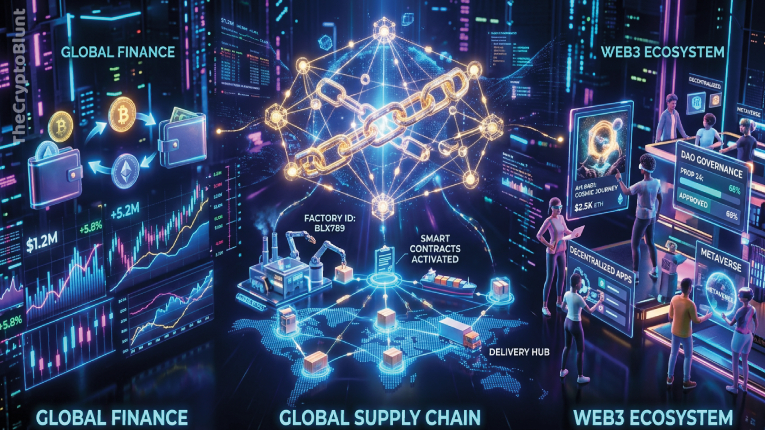
Blockchain technology has evolved from the foundation of cryptocurrencies into a powerful infrastructure layer capable of transforming multiple global industries. Initially associated mainly with Bitcoin, blockchain is now influencing financial services, logistics networks, and the emerging Web3 internet.
By enabling transparent, secure, and decentralized record-keeping, blockchain is reshaping how organizations manage transactions, verify data, and coordinate across global systems. While the technology still faces scalability and regulatory challenges, its long-term potential continues to attract investment from governments, corporations, and technology innovators.
Blockchain’s Core Innovation: Trust Without Intermediaries
The fundamental value of blockchain technology lies in its ability to create tamper-resistant digital ledgers. Transactions recorded on a blockchain are distributed across thousands of nodes, making them difficult to alter or manipulate.
Unlike traditional databases controlled by centralized entities, blockchain networks rely on cryptographic consensus mechanisms. This structure enables multiple parties to share and verify data without relying on a single authority.
For industries that depend heavily on trust, transparency, and verification, this capability can significantly reduce inefficiencies and fraud.
Transforming the Financial Industry
The financial sector has been one of the earliest adopters of blockchain technology. Traditional banking systems often rely on intermediaries for payment processing, settlement, and record-keeping.
Blockchain-based systems allow transactions to be executed directly between participants, reducing delays and operational costs.
For example, decentralized finance platforms built on networks such as Ethereum enable users to lend, borrow, and trade digital assets without traditional banks. These platforms operate through smart contracts—self-executing programs that automate financial agreements.
Key Financial Benefits
- Faster cross-border payments
- Reduced transaction costs
- Greater financial inclusion
- Transparent settlement systems
Many financial institutions are exploring blockchain-based solutions for tokenized assets, digital identity verification, and automated compliance processes.
However, regulatory uncertainty and cybersecurity risks remain important considerations for large-scale adoption.
Improving Global Supply Chains
Supply chain management is another sector where blockchain technology is creating meaningful improvements. Traditional supply chains often involve complex networks of manufacturers, logistics providers, and retailers.
These networks frequently struggle with issues such as data fragmentation, lack of transparency, and counterfeit goods.
Blockchain allows companies to record each step of a product’s journey on a shared ledger. Once recorded, the information cannot easily be altered, creating a permanent and verifiable record of origin, shipping, and delivery.
Practical Applications
- Tracking food safety and agricultural products
- Verifying luxury goods authenticity
- Monitoring pharmaceutical supply chains
- Improving logistics transparency
Major corporations and technology providers have already tested blockchain systems designed to track products across global distribution networks.
By reducing fraud and improving traceability, blockchain can strengthen trust between suppliers, manufacturers, and consumers.
Powering the Web3 Internet
Blockchain also plays a central role in the development of Web3—the next generation of the internet focused on decentralization and user ownership.
In the traditional Web2 model, large technology platforms control user data and digital assets. Web3 aims to shift that power toward individuals through decentralized networks and blockchain-based identities.
Projects within the Web3 ecosystem often rely on tokens and smart contracts to create digital economies where users can own and control their data, content, and online identities.
For instance, decentralized applications (dApps) built on blockchain networks allow developers to create platforms that operate without centralized control.
This approach could fundamentally change industries such as gaming, social media, and digital content distribution.
Challenges and Risks
Despite its potential, blockchain technology still faces several challenges that could slow adoption.
Scalability
Many blockchain networks struggle to process large numbers of transactions efficiently. Although scaling solutions and new architectures are improving performance, the technology is still evolving.
Regulation
Governments worldwide are developing frameworks to regulate blockchain-based financial systems and digital assets. These regulations may influence how blockchain applications operate across borders.
Energy Consumption
Some blockchain networks rely on energy-intensive consensus mechanisms, raising environmental concerns. Alternative systems such as proof-of-stake are being developed to address these issues.
Future Outlook
The long-term trajectory of blockchain technology suggests continued expansion into multiple sectors beyond cryptocurrency.
As infrastructure improves and regulatory clarity increases, blockchain could become a foundational technology for digital economies, enabling new forms of financial services, supply chain transparency, and decentralized internet platforms.
The transformation will not happen overnight, but the direction is clear: blockchain is evolving from a niche innovation into a global technological framework that could reshape how industries operate in the digital age.