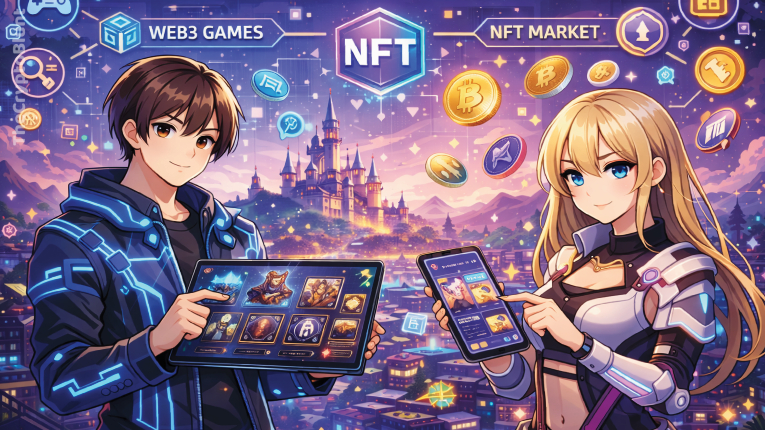
The non-fungible token (NFT) market experienced explosive growth during 2021 and early 2022 before entering a prolonged downturn. Many collections lost significant value, and speculative trading activity declined sharply. However, a new catalyst is emerging: Web3 gaming. Blockchain-based games are increasingly integrating NFTs into gameplay mechanics, creating real utility beyond digital collectibles.
This shift from speculation to utility is widely seen as one of the key forces potentially reviving the NFT ecosystem. By embedding NFTs directly into interactive environments, Web3 games are transforming them from static assets into functional digital items with in-game value.
The NFT Market’s Decline and the Need for Utility
The NFT boom initially revolved around digital art, collectibles, and speculative trading. At its peak, some NFT artworks sold for millions of dollars, but the market later cooled dramatically as speculative demand faded. Reports show that many NFTs lost substantial value after the market correction, highlighting the fragility of purely hype-driven assets.
This collapse forced developers and investors to rethink how NFTs could deliver long-term value. Instead of focusing on collectible artwork alone, the industry began exploring utility-based applications, particularly in gaming and metaverse environments.
This is where Web3 games have started to play a major role.
How Web3 Games Integrate NFTs
Web3 games combine blockchain infrastructure with traditional gaming mechanics. Instead of owning items stored on centralized game servers, players can hold their assets as NFTs on blockchain networks such as Ethereum.
These NFTs represent:
- Characters or avatars
- In-game weapons and skins
- Virtual land
- Collectible items or resources
Because these assets exist on a blockchain, players can trade them in secondary markets or use them across multiple platforms.
This ownership model is one of the biggest differences between Web3 games and traditional gaming ecosystems.
Key Reasons Web3 Games Are Reviving NFTs
True Digital Ownership
Traditional games allow players to purchase items, but those assets remain controlled by the developer. Web3 games change this model by allowing players to fully own their digital items as NFTs.
This ownership model increases player engagement and investment in the game economy. When players know their items can be traded or sold outside the game, the perceived value of NFTs increases significantly.
Research suggests that interest in digital collectibles is rising, with roughly 30% of gamers reporting purchases of virtual collectibles, reflecting a growing demand for ownership in digital environments.
Play-to-Earn and Game Economies
Another major driver of NFT adoption in gaming is the play-to-earn (P2E) model.
In these systems, players earn NFT assets or tokens by completing tasks, winning battles, or participating in the game ecosystem. Successful games have demonstrated how these reward mechanisms can attract large user bases.
For example, earlier blockchain games like Axie-style ecosystems demonstrated that in-game NFT assets could generate billions of dollars in economic activity during peak adoption periods.
However, developers are now redesigning tokenomics to avoid excessive inflation and maintain sustainable economies.
Expanding Web3 Gaming Market
The Web3 gaming sector itself is growing rapidly, providing a strong foundation for NFT demand. Market projections suggest the Web3 gaming industry could expand significantly in the coming decade, driven by blockchain adoption, NFT ownership, and decentralized virtual economies.
In fact, the Web3 gaming market was valued at over $25 billion in 2024 and could exceed $124 billion by 2032, highlighting the scale of potential growth.
As more developers enter the space, the demand for NFT-based assets in gaming ecosystems is likely to increase.
Real-World Examples of Web3 Gaming Expansion
Recent game launches and updates illustrate the growing intersection between gaming and NFTs. For example, the blockchain-integrated mobile game Snaky Cat introduced Web3 features such as blockchain-based items and decentralized gameplay mechanics.
Meanwhile, large NFT brands are also expanding into gaming environments. Projects such as the metaverse initiative from Bored Ape Yacht Club aim to create interactive worlds where NFT ownership is tied directly to gameplay and digital identity.
These developments demonstrate how NFTs are shifting from passive collectibles to active digital assets.
Challenges That Could Slow the Revival
Despite the positive momentum, several challenges still affect NFT gaming.
Gameplay Quality
Early blockchain games were often criticized for prioritizing monetization over gameplay. Surveys have shown that over 40% of gamers viewed NFTs as gimmicky or exploitative, which slowed adoption among mainstream audiences.
For Web3 gaming to succeed, developers must focus on gameplay quality rather than purely economic incentives.
Technical Barriers
Many blockchain games still require users to create crypto wallets and manage digital assets, which can create friction for new players. Improving onboarding and user experience remains a key challenge for the industry.
Market Outlook
The long-term relationship between Web3 gaming and NFTs appears increasingly interconnected. As developers continue to integrate blockchain infrastructure into gaming ecosystems, NFTs may regain relevance as functional digital assets rather than speculative collectibles.
If Web3 games successfully combine engaging gameplay with sustainable token economies, they could provide the next major growth engine for the NFT market.
For now, the sector remains in a rebuilding phase—but the emergence of blockchain-powered gaming suggests that NFTs may be evolving into a new generation of digital ownership rather than fading away.