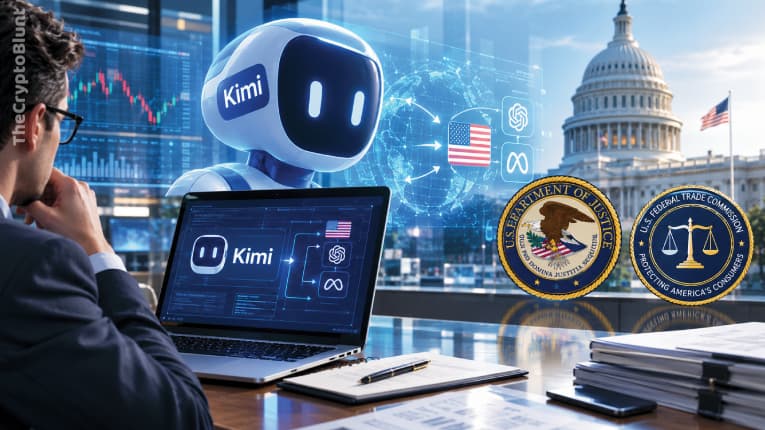
Moonshot, whose Kimi model shook markets earlier this year, is one of six Chinese AI firms accused of systematically extracting capabilities from US-developed models.
US security agencies are accusing six Chinese artificial intelligence companies, including DeepSeek, Alibaba and Moonshot AI, of using American frontier models on an industrial scale to train and improve their own AI systems.
The NSA, FBI and CISA said Tuesday that the companies had extracted billions of tokens through millions of requests from models such as Claude, GPT, Gemini and Grok since at least late 2024. Proxy services and multiple accounts were often used to evade detection and make the activity harder to trace.
The agencies described the activity as malicious knowledge distillation and said it was likely carried out with the awareness of the Chinese government.
Distillation is a widely used AI training method in which developers send large numbers of questions to a more capable model, gather its responses, and use those outputs to help train and improve another model.
U.S. agencies say the Chinese companies took the practice much further, sending millions of carefully crafted requests to American AI models to replicate their coding, mathematical and reasoning capabilities, while multiple accounts and proxy services were used to bypass detection and usage limits.
Stay in the loop
Get crypto news before the market moves
Join thousands of investors who read our daily briefing.
No spam. Unsubscribe anytime.
Moonshot’s Kimi K3 Challenges US AI Dominance#
Moonshot is the developer behind Kimi K3, an open-weight AI model that outperformed Anthropic and OpenAI on a closely watched coding benchmark in July and briefly sparked a wider selloff across the AI market.
Chinese AI stocks bore the brunt of the selloff, with Z.ai sliding about 27% and MiniMax losing roughly 16%. Semiconductor shares also weakened across Asia, while bitcoin and other major cryptocurrencies fell in tandem. The pressure carried into the next session, when South Korea’s Kospi dropped another 3.5%.
At the time that Kimi’s strong performance challenged two widely held assumptions about AI. The first was that developing top-tier models would remain extremely costly, while the second suggested that the most capable systems would continue to come from a small group of heavily funded U.S. companies.
Moonshot demonstrated that a Chinese AI lab could release an open-weight model capable of competing with, and in some benchmarks outperforming, systems from OpenAI and Anthropic without spending anywhere near the massive sums invested by leading U.S. AI firms.
That raised fresh questions among investors about how secure the U.S. lead really was and whether the hundreds of billions being invested in chips and data centers would consistently translate into more capable AI models.