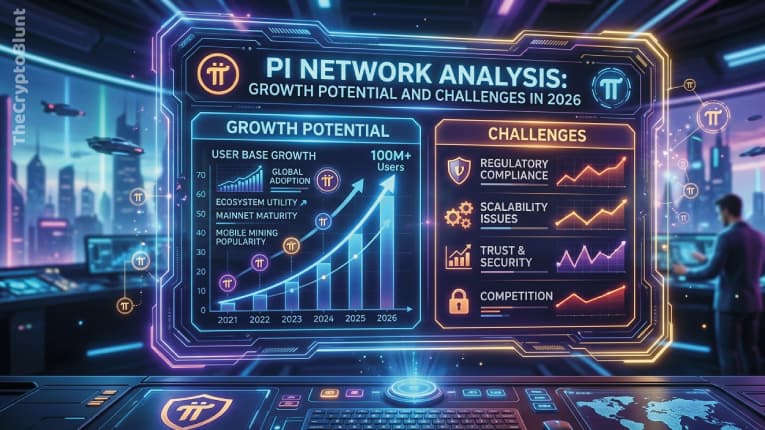
Pi Network has remained one of the most discussed yet controversial projects in the crypto space. Unlike traditional cryptocurrencies such as Bitcoin or Ethereum, Pi Network focuses on mobile-first mining and accessibility, aiming to onboard millions of users into the blockchain ecosystem. As we move through 2026, the project stands at a critical crossroads—balancing massive community growth with increasing pressure to deliver real utility and market value.
While Pi’s price discovery remains limited due to restricted exchange listings, its ecosystem developments and user metrics provide valuable insights into its future trajectory.
Current Market Structure and Price Dynamics#
From a technical standpoint, Pi Network operates in a unique environment where traditional chart-based analysis is limited. Since the token is not widely traded on major exchanges, its price movement is largely speculative and driven by IOU markets or peer-to-peer transactions.
Despite this limitation, the implied price range has shown relative stability with periodic spikes, indicating speculative demand during major announcements or ecosystem updates. This suggests that market participants are actively monitoring developments, even in the absence of full liquidity.
The lack of open market trading also creates artificial supply constraints, which can lead to exaggerated price movements once broader listings occur.
Growth Drivers Behind Pi Network#
Massive User Base Expansion#
One of Pi Network’s strongest advantages is its rapidly growing user base. With tens of millions of users globally, Pi has achieved a level of adoption that many blockchain projects struggle to reach.
This network effect creates a strong foundation for future growth, as a large user base can drive ecosystem activity once full functionality is enabled.
Mobile-First Accessibility#
Pi’s mobile mining model lowers the barrier to entry, allowing users to participate without expensive hardware. This accessibility has been a key factor in its global adoption, particularly in emerging markets.
Ecosystem Development#
The transition toward Pi’s mainnet and the development of decentralized applications (dApps) are critical milestones. A functioning ecosystem with real use cases could significantly increase demand for the token.
Technical and Fundamental Challenges#
Limited Liquidity and Exchange Listings#
The biggest challenge for Pi Network is the lack of widespread exchange listings. Without open trading, price discovery remains inefficient, and investor confidence is limited.
A major exchange listing would likely act as a catalyst for volatility, potentially leading to both sharp gains and corrections.
Centralization Concerns#
Critics argue that Pi Network remains relatively centralized compared to established cryptocurrencies. Questions about governance and control could impact long-term adoption.
Delayed Mainnet Progress#
While progress has been made, delays in fully launching an open mainnet have created uncertainty. This has led to skepticism among some investors and analysts.
Stay in the loop
Get crypto news before the market moves
Join thousands of investors who read our daily briefing.
No spam. Unsubscribe anytime.
Market Sentiment and News Developments#
Recent developments suggest that Pi Network is gradually moving toward greater transparency and functionality. Updates related to KYC verification, ecosystem expansion, and developer activity indicate progress.
However, the absence of major exchange listings continues to dominate market sentiment. Traders are closely watching for announcements that could signal a shift toward open market trading.
The broader crypto market also plays a role. When major assets like Bitcoin experience bullish momentum, speculative interest in emerging projects like Pi tends to increase.
Bullish Scenario: Unlocking Potential#
In a bullish scenario, several factors could drive Pi Network’s growth:
- Successful open mainnet launch
- Listings on major exchanges
- Expansion of real-world use cases
- Increased developer activity
If these conditions are met, Pi could transition from a speculative project to a functional ecosystem, potentially leading to significant price appreciation.
Bearish Risks and Downside Factors#
Despite its potential, Pi Network faces notable risks:
- Continued delays in development
- Lack of transparency or regulatory clarity
- Declining user engagement over time
- Increased competition from established blockchain projects
If these challenges persist, Pi may struggle to maintain momentum and could lose relevance in a rapidly evolving market.
Technical Outlook: What to Watch#
Even without traditional charts, several indicators can help assess Pi’s trajectory:
- User growth trends: Continued expansion signals strong adoption
- Ecosystem activity: More dApps indicate increasing utility
- Exchange developments: Listings would drive liquidity and price discovery
- Market sentiment: Community engagement remains a key driver
Monitoring these factors provides a clearer picture of Pi’s long-term potential.
Final Outlook#
Pi Network represents a unique experiment in the cryptocurrency space, combining mass adoption with a mobile-first approach. Its growth potential is significant, driven by a large user base and ambitious vision.
However, the project also faces substantial challenges, particularly in achieving decentralization, liquidity, and real-world utility. The coming months will be critical in determining whether Pi can transition from a conceptual network to a fully functional blockchain ecosystem.
For investors and observers, Pi Network is a high-risk, high-reward opportunity. Its success will depend on execution, transparency, and the ability to deliver on its promises in an increasingly competitive market.