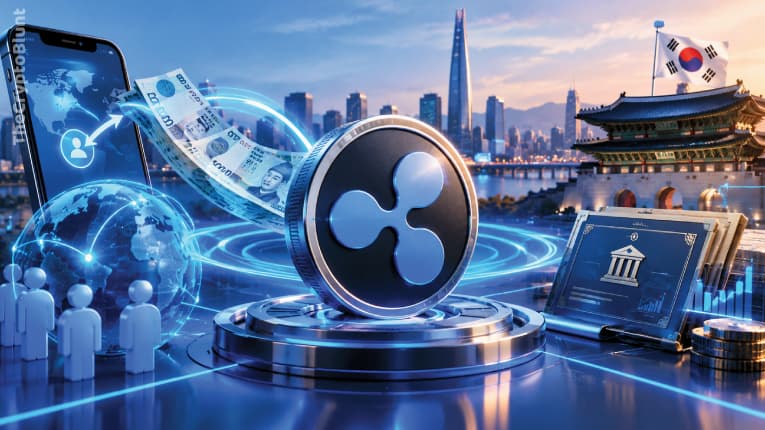
Ripple has expanded its footprint in Korea by linking international business payments, bank-managed crypto wallets, and blockchain settlement for government bonds. By teaming up with Meritz Securities, the firm extends this momentum directly into capital markets, where digital assets are being integrated by regulated institutions.
Four Korean Partnerships Expand Ripple Beyond Cross-Border Payments#
Cross-border payments and government bond settlements form the backbone of Ripple’s expanding institutional network in Korea, which has recently stretched into the brokerage sector. The blockchain infrastructure provider revealed this growth following its October 14 custody and tokenization deal with Meritz Securities, marking its fourth major Korean financial partner this year and its first within the securities industry.
The agreement positions Meritz alongside life insurer Kyobo Life Insurance, online lender Kbank, and regional firm Jeonbuk Bank, each tackling distinct financial operations. Ripple and Meritz focus their collaboration on Ripple Custody and digital asset representation tools, giving Meritz an established platform that can be evaluated for secure storage, transfer, and settlement.
Fiona Murray, Ripple’s managing director for Asia Pacific, framed the firm’s broader suite as spanning payments, custody, and tokenization. She highlighted over 85 licenses alongside a reach across more than 60 global markets, ensuring these Korean agreements are anchored within Ripple’s worldwide infrastructure.
Byungha Kang, managing director of the Strategic Planning Unit at Meritz Securities, outlined the direction that will be pursued through this collaboration:
“This partnership lays the foundation for combining Ripple’s global digital asset infrastructure with our capital markets capabilities. As Korea’s regulatory framework evolves, we will prepare safe and trusted digital asset financial services in stages.”
From Corporate Remittances to Tokenized Government Bonds#
Jeonbuk Bank’s adoption of Ripple Payments links the broader institutional strategy to local businesses transferring money internationally. Announced on August 18, the cross-border remittance deal made Jeonbuk the first regional bank in Korea to roll out the network. Ripple claims the platform operates around the clock, allowing rapid settlement that can be completed in seconds to minutes for import-export firms, tech startups, and digital content creators.
Stay in the loop
Get crypto news before the market moves
Join thousands of investors who read our daily briefing.
No spam. Unsubscribe anytime.
Kyobo Life Insurance’s government bond initiative leverages Ripple Custody to test blockchain-driven processing for public debt. The insurer and Ripple are evaluating the technical and regulatory requirements to hold, transfer, and settle tokenized government bonds. Through this effort, manual procedures are set to be replaced by on-chain execution to achieve near-real-time settlement.
Kbank is deploying institutional digital asset wallets to manage crypto holdings across various blockchain networks within a regulated banking framework. Korea’s pioneer internet-only bank will utilize Ripple Custody to generate wallets, authorize transfers, and oversee assets. Through these built-in security features, the need to build and maintain a proprietary architecture is significantly reduced.
Meritz Outlines a Phased Path Into Digital Asset Finance#
Meritz’s exploration of digital asset ventures encompasses spot ETFs, fractional investments, security tokens, trading platforms, and won-denominated stablecoins. The firms will start within Meritz’s current securities operations under existing rules, expanding their collaboration as new regulatory frameworks are established in Korea.
Those potential services rely on the ability to hold digital assets securely and map financial rights onto a blockchain. Blockchain tokens can represent ownership or other rights tied to an underlying asset. Tokenization produces these digital representations, while custody supplies the controls through which they are stored and transferred.
South Korea’s Financial Services Commission proposed new rules on October 1 for issuing and trading tokenized securities, encompassing stocks, bonds, funds, and fractional assets. The proposed framework aligns with updated electronic registration and securities laws scheduled to take effect on February 4, 2027. Public feedback will be gathered through November 11 before the measure is submitted for final approval.