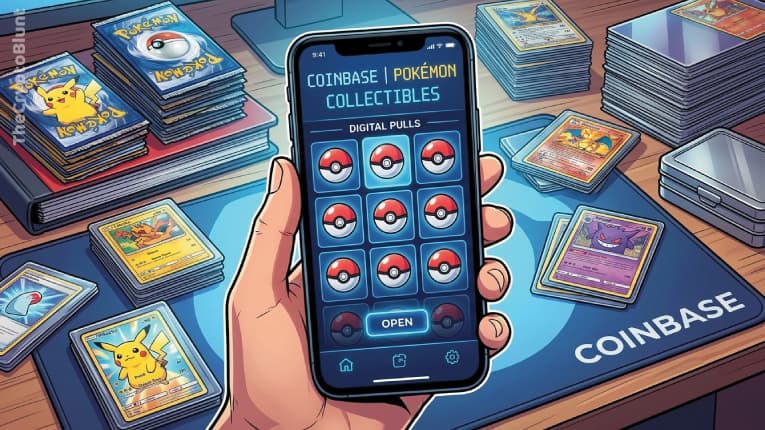
Coinbase envisions customers unboxing digital Pokémon cards on mobile devices while securing tangible collectibles they might never physically hold. Their September 28 teaser guaranteed physical safeguarding, secure vault storage, and doorstep shipping upon demand, thrusting the cryptocurrency marketplace into an arena where GameStop already markets virtual booster packs priced up to $2,500. Intriguingly, within pre-existing decentralized iterations of this ecosystem, a tokenized card is transferred across owners instantly without shifting locations. Coinbase has not been completely forthcoming regarding whether its upcoming utility will operate identically.
While a physical Pokémon card remains stationary inside a secure vault, a buyer can acquire it through a virtual unboxing, instantly trade it to another collector, and repeat the cycle. No mailer moves. Nobody needs to clear binder sleeves for storage. Now, Coinbase seeks entry into this market. On September 28, the cryptocurrency exchange previewed mobile-based pack openings backed by tangible trading cards.
Purchasers can decide whether to keep their collectibles in secure storage or request home delivery. This pitch introduces a classic collecting hobby to a specialized financial network, although one massive inquiry remains unaddressed. What, precisely, will be received by customers for their cash?
The Pack Opens, but the Card Stays Put#
Coinbase’s announcement presented a product framework rather than a final instruction manual. Users unlock a mobile pack, uncover a physically backed collectible, and then select storage or shipping. Promotional visuals displayed five Pokémon-themed packs labeled 01 through 05. Distinct colors implied diversity, but Coinbase has not revealed whether they indicate pricing tiers, card categories, or another classification entirely.
Although the initial written announcement avoided naming Pokémon, Coinbase subsequently confirmed the connection in a reply to a user. A firm release date was not provided. Furthermore, the announcement and follow-up exchanges left resale features unconfirmed. That final omission matters significantly. Collecting a card and trading it constitute two distinct propositions, even when both actions occur on the exact same screen.
How a Cardboard Card Gets a Digital Owner#
Courtyard.io alongside alternative platforms provides an established precedent regarding how blockchain integration operates. Within Courtyard, a physical collectible is maintained in secure custody, while a non-fungible token, or NFT, embodies that specific asset. This mechanism functions as a transferable digital claim linked directly to an individual card.
A mystery-pack unboxing uncovers whichever collectible is obtained by the buyer. The owner can keep it vaulted, list it for sale, or request doorstep delivery. Courtyard’s marketplace enables collectors to buy and sell those vaulted items, avoiding a fresh shipment every time ownership changes. The Pokémon card is the authentic article. The token serves as the mechanism for recording and transferring the claim to it.
When someone eventually requests the physical card, Courtyard mandates identity verification and payment for relevant shipping charges and taxes. It then destroys, or “burns,” the matching token as part of the redemption process. This prevents a circulating digital claim from remaining attached to a card already shipped out the door. Courtyard’s redemption documentation details that operational trade-off. This highlights an established model. Coinbase has not specified whether it will employ identical machinery.
GameStop Already Has $2,500 Pokémon Packs#
Coinbase is entering a market populated by several active competitors. American retail giant GameStop launched Power Packs to the general public on April 15, 2026, offering digital packs containing physical cards authenticated and graded by PSA for quality and condition. Power Packs pricing spans from $25 to $2,500, with Pokémon, football, basketball, and baseball serving as featured categories. Customers can sell their cards back, arrange shipment, or keep them securely vaulted.
Stay in the loop
Get crypto news before the market moves
Join thousands of investors who read our daily briefing.
No spam. Unsubscribe anytime.
The premium pack costs 100 times the baseline entry price. This enterprise has already expanded far beyond a simple impulse purchase at a retail checkout counter. Furthermore, GameStop’s service clarifies an important distinction by showing that opening digital packs does not automatically equal blockchain-based ownership. Their published launch materials outline tangible cards and secure custody without incorporating the NFT architecture utilized by Courtyard. Conversely, Coinbase’s brand recognition alone fails to resolve that specific question regarding their upcoming offering either.
A Fair Draw Can Still Come at a Cost#
Phygitals, an alternative physically backed trading card ecosystem, promotes immediate buybacks ranging from 85% to 90% of a card’s estimated fair market value. For an item assessed at $100, this guarantees $85 to $90. This does not mean the purchaser recovers 85% to 90% of the initial pack expenditure. The percentage tracks the card’s evaluated worth, a distinction worth reviewing prior to purchase. Phygitals explicitly details its buyback pricing alongside its pack options.
The platform also promotes publicly verifiable randomness: a selection mechanism featuring cryptographic proof that users can audit. This solves how an outcome is determined. It fails to guarantee that every card is priced accurately, that inventory logs are maintained completely, or that the physical goods are secured safely in custody. Nor does a verifiable draw promise profitability. A randomly chosen card can be valued below the cost expended to acquire it.
An Exchange Reaches for the Binder#
Coinbase has linked its recent preview to broader “Everything Exchange” aspirations that stretch past traditional cryptocurrency trading. Collectibles naturally complement this vision since ownership can transfer independently of the physical item itself. Within an established vaulted marketplace, a Pokémon card that previously demanded online listings, protective packaging, and postal delivery can change hands among collectors while sitting stationary on the exact same shelf.
This framework offers genuine practical appeal. It simultaneously shifts the entity entrusted by the consumer. Human operators must still authenticate the Pokémon card, safeguard the inventory, maintain accurate ledgers, and dispatch the correct merchandise whenever an owner requests home delivery. Distributed ledgers can track ownership transfers effectively; however, physical storage and shipping logistics remain managed by people and corporate enterprises.
The Details Remain Inside the Wrapper#
Coinbase has omitted details concerning Pokémon pack pricing, pull probabilities, storage fees, shipping logistics, and eligible geographical regions. Furthermore, the exchange has not named its physical card custodian, verified grading benchmarks such as PSA, or clarified whether users will be permitted to resell items through the platform. Its technical framework remains unrevealed as well, including whether ownership will be tracked via a distributed ledger network. Knowing Coinbase, blockchain integration is anticipated. Additionally, a formal licensing partnership with The Pokémon Company has not been publicized.
Those answers will determine whether consumers secure a streamlined collecting experience, access to a vibrant marketplace, or a hybrid of both. For now, Coinbase has unveiled only the outer packaging. Collectors still require pricing details, pull odds, and the operational terms governing physical retrieval.