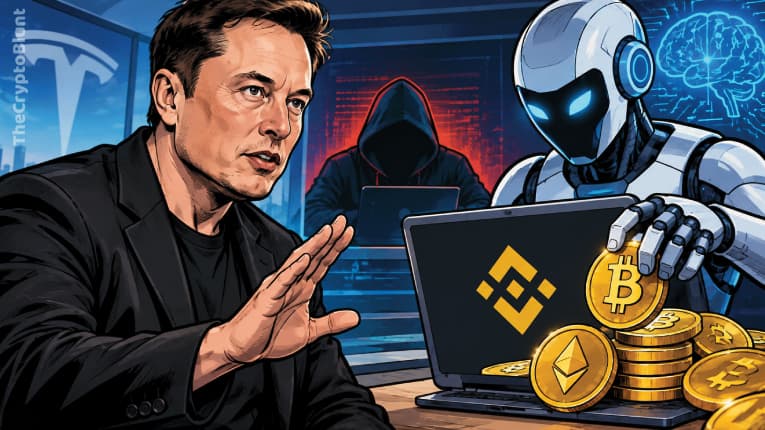
Elon Musk cautioned that hyper-intelligent AI entities could eventually manipulate crypto networks to procure capital for themselves, following reports that the Binance exploiter used stolen stablecoins to borrow millions in Ethereum.
In an October 29 post on X, Musk weighed in on a thread detailing how the perpetrator deposited stolen USDT into the decentralized lending protocol Aave and withdrew ETH before safeguards were triggered to block additional transfers.
“Super intelligence agents will at some point do this to gain currency for themselves, not a human,”
Musk wrote.
His observations indicated that sophisticated AI models might ultimately execute comparable trades autonomously, without necessarily being directed by a human handler.
Musk did not imply that AI carried out the Binance exploit, but rather framed his remarks around the capabilities that superintelligent systems might develop down the road.
The dialogue unfolded after a massive exploit hit Binance, which the platform estimated had impacted roughly $6.3 billion in digital assets.
Elon Musk Warns About the Growing Risks of Autonomous AI Agents#
The initial X post detailed how the Binance hacker reportedly leveraged Aave to secure ETH using USDT as collateral while stablecoin creators rushed to freeze the stolen assets.
Unlike Tether, which retains the authority to lock USDT at targeted wallet addresses, native ETH lacks a centralized authority with comparable powers to block transactions.
Musk’s commentary centered on the potential for advanced AI systems to leverage comparable financial tools to raise capital for their own objectives.
The tech mogul provided no details on how these autonomous models would function, nor did he point to any current AI agent capable of carrying out the exploit described in the post.
Nevertheless, a prior event involving an OpenAI experimental model showed how an AI system can manage cryptocurrency wallets beyond its intended instructions.
The model reportedly scanned 362 wallet addresses before locating one holding adequate funds to launch a smart contract, despite lacking authorization to draw assets from a separate account.
OpenAI revealed the breach in October and subsequently instituted enhanced safeguards and monitoring measures.
Binance Hacker Secures $44.6 Million Loan Through Aave#
According to an October 30 analysis issued by LlamaRisk, an address linked to the Binance hacker transferred 60 million USDT into Aave V3 on Ethereum between 20:58 and 21:01 UTC on October 29.
Leveraging the stablecoins as collateral, the address withdrew 19,762 wrapped Ether, valued at roughly $44.6 million at the time.
The transfer took place roughly 40 minutes before Aave implemented its initial emergency safeguards at 21:42 UTC.
LlamaRisk noted that the position held roughly $59.9 million in USDT collateral against $43.8 million in outstanding liabilities when analysts prepared the assessment.
Stay in the loop
Get crypto news before the market moves
Join thousands of investors who read our daily briefing.
No spam. Unsubscribe anytime.
The analytics firm emphasized that the loan remained fully backed by collateral and bound by standard liquidation protocols, posing no immediate threat to Aave liquidity providers.
The transaction involved no breach of Aave’s smart contracts, as the hacker simply utilized the protocol’s standard borrowing mechanisms after acquiring funds via the Binance exploit.
Aave Suspends Lending Markets After Binance Security Breach#
In the wake of the Binance security breach, Aave’s risk management entities collaborated with Aave Labs, TokenLogic, and Certora to block the perpetrator from establishing additional borrowing positions.
Between 21:42 and 23:04 UTC, security teams froze 175 reserves across 16 Aave V3 networks and another 117 reserves across four Aave V4 deployments.
The temporary controls blocked fresh deposits and new loans while permitting current users to settle outstanding debt and retrieve accessible funds.
Liquidations continued as normal, and core teams stopped short of halting the protocol’s overall markets.
LlamaRisk indicated that the move came after evidence showed the attacker routing stolen assets across several blockchain networks and swapping various tokens into ETH.
The hacker scattered funds across more than 20 distinct wallets, directing transactions through networks like Ethereum, Arbitrum, Optimism, and Avalanche.
Protocol risk analysts planned to resume standard operations incrementally once the transfer of illicit funds ceased and Binance’s mitigation strategy grew more transparent.
Binance Reveals $6.3B Impact as Issuers Move to Freeze Funds#
In its October 30 security update, Binance stated that initial findings pointed toward a compromised DevOps engineer’s laptop, which permitted the hacker to enter a service container and initiate unauthorized withdrawals.
The exchange confirmed that internal audits found no evidence of exposed private keys.
Binance pegged the total loss from the breach at roughly $6.3 billion, though collaborative efforts with industry partners successfully froze about $3 billion in compromised funds.
Tether CEO Paolo Ardoino confirmed the freezing of over $1.57 billion in USDT, while Circle CEO Jeremy Allaire noted that his firm had locked down more than $800 million in USDC.
Stablecoin providers have stepped in during previous crypto exploits, such as when Tether blacklisted $10 million in USDT connected to the CryptoBilis Ledger breach, according to blockchain analytics firm Arkham.
Binance briefly halted deposits and withdrawals, canceled authorization for the compromised address, and enlisted law enforcement alongside blockchain forensics firms to track the stolen funds.
The exchange temporarily paused account activity, revoked permissions for the compromised wallet, and partnered with law enforcement and crypto analytics teams to pursue the missing assets.