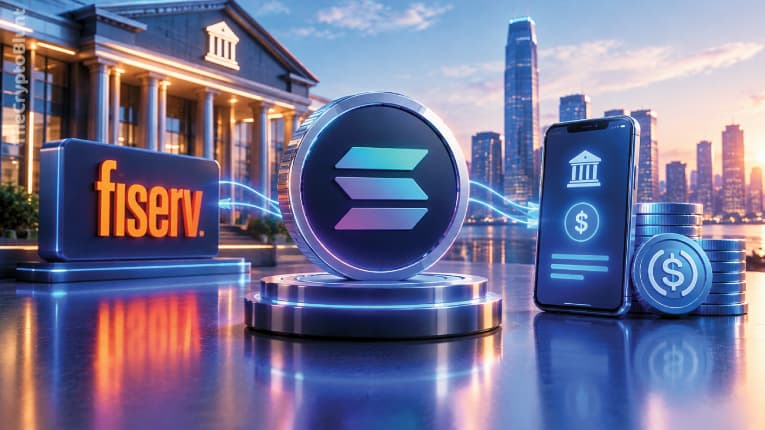
Marking the debut of Fiserv’s fresh digital asset platform, Bank of North Dakota’s Roughrider Coin has been integrated as its inaugural live application, a rollout that brings the system to over 90 credit unions and banks across the state.
Announced by Fiserv on October 1, the dollar-backed token is currently operating on its banking network, with VersaBank USA serving as the issuer, Fireblocks providing the digital asset tech, and Solana handling the blockchain transactions.
Fiserv Puts Roughrider Coin Into Production Banking Use#
Access to Roughrider Coin is provided to participating financial institutions via Commercial Center, the Fiserv network already utilized by them for commercial banking and interbank transfers, while support for the token’s issuance, reserve management, custody, and settlement is handled by the platform.
Bringing an initiative initially unveiled in October 2025 into live operation, this launch follows a prior announcement by Fiserv and the Bank of North Dakota detailing that Roughrider Coin would serve as the state’s inaugural stablecoin powered by Fiserv’s digital-asset framework, with its rollout scheduled for 2026.
Past reports on North Dakota’s Roughrider Coin initiative highlighted the state bank’s choice to design the token exclusively for local credit unions and banks, while the project was first introduced as a mechanism to back quicker interbank settlements and upcoming payment utilities.
Fiserv has kept details under wraps regarding the exact volume of Roughrider Coin issued, the number of institutions that have completed transactions, and the total value of settlements handled since rollout, noting only in its October 1 announcement that the platform and initial application are live without sharing specific transaction metrics.
Roughrider Coin Is Available Only to Financial Institutions#
The access boundaries are laid out clearly in the description from the Bank of North Dakota, which points out that Roughrider Coin is a permissioned dollar-backed token built strictly for interbank transfers among North Dakota community banks and credit unions, meaning everyday consumers cannot purchase, own, or invest in it.
The project partners use slightly varying language, as Fiserv and VersaBank label Roughrider Coin a dollar-backed stablecoin, whereas the Bank of North Dakota currently refers to it as a “token deposit for financial institutions,” though both descriptions emphasize that the product remains limited to institutional banking use and is backed on a one-to-one basis by U.S. dollars.
Governance and oversight are supplied by the Bank of North Dakota, but the legal issuer role is held by VersaBank USA, National Association, which distributes the token via Fiserv’s network, while federal banking records point to VersaBank USA as a national bank primarily regulated by the Office of the Comptroller of the Currency.
No separate public crypto interface is required for banks to utilize the product, and Bank of North Dakota explains that initiation, approval, and settlement are handled inside Fiserv’s digital asset platform through the exact same operational channels already used by institutions for ACH transfers and wires.
VersaBank Issues the Token While Solana Handles Transactions#
Confirmation was provided by VersaBank that issuance of Roughrider Coin, along with the handling of minting, burning, custody, and reserve asset management, is managed by its U.S. subsidiary, and the product was highlighted by the bank as the inaugural live deployment on Fiserv’s digital asset platform.
Every Roughrider token is backed one-to-one by U.S. dollars, as stated by the Bank of North Dakota, while reconciliation is handled by Fiserv, and an oversight role over the system is maintained by BND.
Stay in the loop
Get crypto news before the market moves
Join thousands of investors who read our daily briefing.
No spam. Unsubscribe anytime.
Blockchain transactions are verified on Solana, and the Bank of North Dakota notes that Solana’s Token-2022 controls are utilized by the asset, including permissioning features like freeze and clawback functions that can be applied in institutional settings.
Multi-party computation wallets and digital-asset infrastructure are supplied by Fireblocks, and BND points out that wallets secured by Fireblocks are utilized by participating institutions alongside automated compliance rules and operational safeguards built for financial institutions.
Keeping Roughrider Coin separate from a public retail stablecoin open to free public trading, the architecture places access controls directly at the token level, whereas issuance and reserve management are maintained by an OCC-regulated U.S. bank.
Fiserv Is Building Beyond a Single North Dakota Token#
Back in June 2025, Fiserv unveiled its digital-asset platform alongside plans for FIUSD, its proprietary bank-oriented dollar stablecoin, while explaining that the infrastructure would integrate seamlessly with current Fiserv banking offerings and utilize its Finxact core-processing system as the underlying ledger.
Incorporating infrastructure from Circle and Paxos alongside Solana support, that previous roadmap was outlined by Fiserv while noting that its broader network encompassed partnerships with approximately 10,000 financial institutions and six million merchant locations handling roughly 90 billion transactions yearly.
Designed to ensure interoperability with other dollar-backed assets and seamless integration into existing Fiserv banking and payment products, the initial FIUSD strategy on Solana has led to Roughrider Coin emerging as the very first offering explicitly identified by Fiserv as active on its digital-asset platform.
Fiserv’s October 1 announcement outlines that the platform is capable of powering stablecoin card issuance, cross-border payments, programmable commerce, and treasury automation, while also supporting tokenized deposits and global currency accounts, including U.S. dollar accounts for foreign financial institutions.
Fiserv has withheld any specific timeline for rolling out all anticipated applications into full production, though its previous FIUSD efforts involved mapped interoperability with PayPal USD following a 2025 partnership between Fiserv and PayPal centered on domestic and cross-border stablecoin transfers.
North Dakota to Detail Roughrider Coin Rollout Next Week#
The Bank of North Dakota has lined up additional public conversations regarding the project during its upcoming B3 Forum in Medora, scheduled to run from October 5 through October 7.
The event schedule published by the bank features a press conference dedicated to Roughrider Coin on October 5 at 4:30 p.m., which is set to be followed by a focused panel discussion covering the coin on October 7 between 10 a.m. and 11 a.m.
Taking place just days after the production rollout, these sessions aim to provide North Dakota financial institutions with deeper insights into the novel settlement rail, while the Bank of North Dakota has yet to release public data detailing total Roughrider Coin supply, reserve size, or transaction volume since the platform went live.