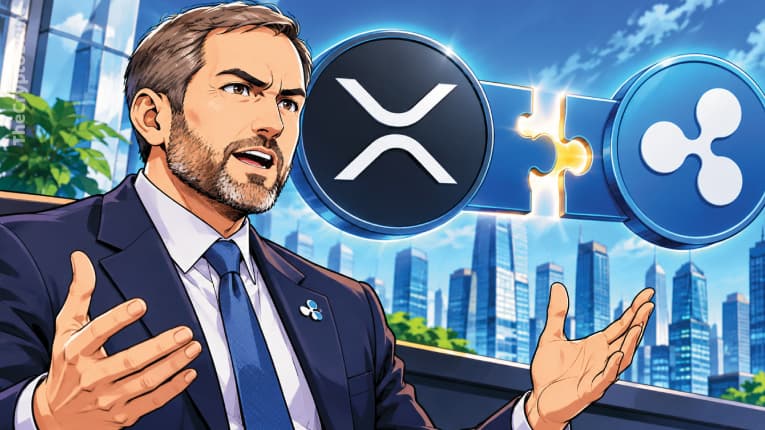
Ripple USD (RLUSD) works alongside XRP while competing with other stablecoins, according to Ripple CEO Brad Garlinghouse. The connection between both assets was framed by Garlinghouse around customer needs and his goal of driving more financial activity onto the XRP Ledger.
Garlinghouse Highlights RLUSD’s Role Alongside XRP#
Ripple CEO Brad Garlinghouse clarified on X on Nov. 3 that RLUSD and XRP fulfill distinct yet complementary roles, positioning rival stablecoins as RLUSD’s true market competition. The relationship was addressed by Garlinghouse in separate replies to users on the platform who were debating liquidity dynamics and the contrasting functions of both digital assets.
Garlinghouse outlined where RLUSD competes:
“RLUSD isn’t competing with XRP. It’s competing with other stablecoins. Use case matters, and I want those use cases running on the XRPL.”
His remarks built on a thread contending that deeper liquidity across the XRP Ledger (XRPL) could eventually smooth XRP’s practical usage, even if price changes without direct utility remain secondary. A broader debate on adoption was sparked by the post, questioning whether XRP will evolve into a niche institutional asset with tight liquidity or capture mainstream market use.
How XRP Powers RLUSD Transactions Across the XRP Ledger#
For businesses clearing dollar-based obligations, RLUSD delivers a settlement token structured to uphold a stable dollar value through its reserve backing and redemption mechanics. Payments, remittances, and corporate treasury flows were identified by Ripple among its target applications. That framework enables a firm to transfer dollar balances onchain while keeping its liabilities and payouts denominated in the exact same currency.
Every RLUSD transfer across the XRPL remains subject to the network’s standard XRP Transaction fee
requirements, burning a fraction of XRP in the process. That small fee is permanently destroyed, with exact costs shifting according to network congestion and transaction complexity. Because this fee operates completely independently of the underlying transfer, sending RLUSD never requires converting the payment balance into XRP.
Stay in the loop
Get crypto news before the market moves
Join thousands of investors who read our daily briefing.
No spam. Unsubscribe anytime.
Beyond standard network fees, XRP can bridge tokenized markets whenever routing trades through it yields a better exchange rate than a direct swap. This liquidity-routing capability alongside RLUSD was described by Evernorth chief business officer Sagar Shah back in May, framing the stablecoin as the core dollar-based asset. The ledger’s built-in exchange engine can bundle direct paths with multi-hop XRP routes to lock in optimal execution rates.
Ripple’s Asset Strategy Is Driven by Changing Customer Needs#
In a follow-up response to another X user, the distinct functions of RLUSD and XRP were endorsed by Garlinghouse:
“Complementary, not competitive.”
The message he answered noted that accounts must maintain minimum XRP reserves, whereas users opt into RLUSD by creating a trust line—an account feature designed for receiving issued tokens. XRP itself can be held without configuring any such trust line setup.
During Swell, Ripple’s yearly conference, a customer-centric strategy for driving XRP adoption was outlined by Garlinghouse in statements shared Oct. 28. He noted that Ripple plans to deploy XRP wherever it fits client demands, opting for fiat currencies or RLUSD across other transactions. Ultimately, he preferred having XRP power a modest portion of a client’s volume over losing that activity entirely.
Among institutional custodians supporting both tokens, BNY confirmed Oct. 27 that approved clients can safeguard, hold, and move XRP and RLUSD via its custody infrastructure. That capability was integrated by the bank within its established governance and operational guardrails. This expanded custody suite builds directly upon BNY’s foundational role as the principal custodian for RLUSD reserves.