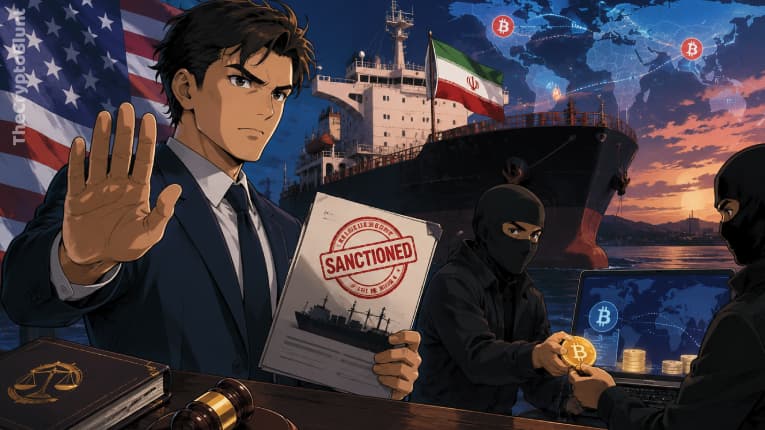
The US Treasury said HormuzSafe accepted Bitcoin and other digital assets to evade sanctions and generate revenue for Iran’s Islamic Revolutionary Guard Corps (IRGC).
The US Treasury has imposed sanctions on two Iranian maritime companies accused of operating within an Islamic Revolutionary Guard Corps (IRGC)-backed insurance network, stating that one of the firms accepted Bitcoin (BTC) and other digital assets to help bypass Western sanctions.
On Wednesday, the Treasury’s Office of Foreign Assets Control (OFAC) said Persian Gulf Marine Insurance Company and HormuzSafe Marine Services Authority played key roles in what it described as an IRGC-backed insurance network that required commercial vessels to purchase approved coverage before passing through the Strait of Hormuz. Both firms were sanctioned for operating within Iran’s financial sector.
The move follows earlier reports that Iran was considering a Bitcoin-based maritime insurance platform. US authorities now allege the network generated revenue for the IRGC. The Treasury also sanctioned eight companies connected to Iran’s shadow fleet and designated eight vessels as blocked property.
OFAC said HormuzSafe accepted Bitcoin (BTC) and other cryptocurrencies as part of efforts to bypass sanctions. The agency alleged that the platform generated revenue for the IRGC while helping Iran strengthen its control over shipping traffic through the Strait of Hormuz.
“The United States will not allow Iran to hold global commerce hostage,” Treasury Secretary Scott Bessent said, accusing the Iranian regime of using international shipping to generate funding for the Islamic Revolutionary Guard Corps (IRGC).
Stay in the loop
Get crypto news before the market moves
Join thousands of investors who read our daily briefing.
No spam. Unsubscribe anytime.
HormuzSafe Moves From Reported Proposal to US Sanctions List#
On May 18, screenshots of the HormuzSafe website circulated online showing “digital insurance” for maritime cargo, with policies available for purchase using Bitcoin. At the time, reports indicated Iran was still evaluating the insurance-based model, while the website was inaccessible when it was checked.
Iranian state-affiliated media outlet Fars News Agency said the proposed platform could issue marine insurance policies and certificates of financial responsibility while potentially generating more than $10 billion in revenue.
The Strait of Hormuz carries roughly one-fifth of the world’s oil trade, making any effort to monetize or exert greater control over traffic through the waterway highly significant for global energy markets.
Earlier reports, citing the Bitcoin Policy Institute, said Iran accepted oil transit payments in Chinese yuan, Tether USDt (USDT), and Bitcoin. However, no onchain evidence had yet confirmed that any Bitcoin payments were actually made.
Bitcoin may appeal to sanctioned entities because it has no centralized issuer that can freeze funds, unlike centralized stablecoins, whose issuers can block specific wallet addresses. In April, US authorities froze $344 million worth of USDT linked to Iran.