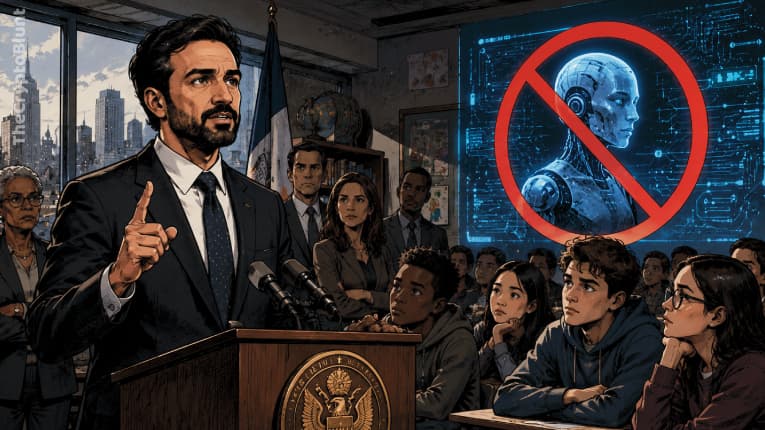
Access to generative AI tools was abruptly cut off for nearly 600,000 students, while metered pilots continue to be operated in high schools by five designated vendors.
Generative AI use has been banned for students from 2-K through the eighth grade across New York City for a full year, according to Mayor Zohran Mamdani and Schools Chancellor Kamar Samuels, who described the initiative as the most comprehensive directive nationwide.
Beginning with the 2026-27 academic term, the suspension impacts approximately 600,000 pupils, representing two-thirds of total district enrollment. Every software platform featuring student-facing generative AI is prohibited, and companion chatbots are banned across all grade levels, including high schools.
Mamdani stated that the tech industry tries to portray AI-driven early education as both inevitable and essential. “We do not see it that way,” he remarked, emphasizing that children require educators and human interaction to learn and develop properly.
Teaching AI Literacy in Modern Education#
During the upcoming year, the city intends to evaluate the impacts of AI, Mamdani explained, as officials adopt a cautious stance toward the technology.
Up to 50,000 high school students, roughly 5% of the system, will engage with vetted tools in a maximum of five classes per school. English classrooms will deploy the text analysis tool Quill for no more than 15 minutes a week, while the math coaching platform Edia is utilized for 20 minutes, and Intel AI-Ready Schools operates one period weekly for semester-long projects. The remaining slots are filled by Brisk Teaching and Playlab, with the latter restricted to two assignments each marking period.
Stay in the loop
Get crypto news before the market moves
Join thousands of investors who read our daily briefing.
No spam. Unsubscribe anytime.
Two 45-minute AI literacy modules will also be undertaken by every high schooler each year, covering what the technology is, along with bias, risks, ethics and career impacts.
AI is kept by educators for lesson planning and operational tasks wherever the tools meet municipal safety standards. Exceptions also cover assistive technology for students with disabilities, multilingual learners and career readiness programs such as computer science.
Device usage will also be restricted for pupils, as screen time faces stricter limits. Second graders and younger experience curtailed one-to-one digital access, while recommended daily maximums reach 30 minutes for grades three through five and 45 minutes for grades six through eight.
Every technology tool in city schools is currently subjected to review, and non-essential functionalities not deemed critical to learning will be dropped. Recommendations for subsequent years will then be published by a newly formed Technology in Schools Coalition—comprising students, educators, parents, unions, advocates, and elected officials—following their assessment of the moratorium and pilots.
The career-readiness access was welcomed by Julie Samuels, head of the trade group Tech:NYC and a coalition member, who recommended expanding it beyond an hour a week in the future, while citing a recent report showing that New York City now hosts more tech jobs than the Bay Area.