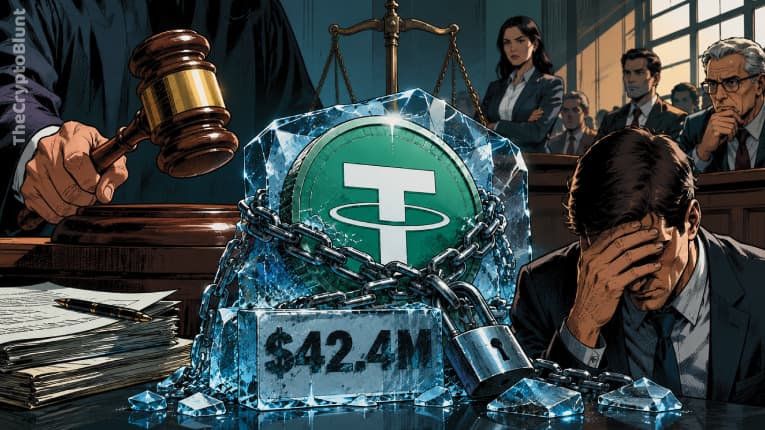
Two Thai businessmen filed a lawsuit against Tether on Aug. 31 in the U.S. District Court for the Southern District of New York, disputing the issuer’s authority to freeze roughly 42.4 million USDT before a seizure warrant was obtained by authorities.
Nutthawat Rukthammachalern and Natthawat Kasamvilas claimed in their complaint that Tether blacklisted ten Ethereum addresses holding exactly 42,417,785.62 USDT on Oct. 30, 2025. The claims have not yet been adjudicated, while Tether had not submitted a public response by Sept. 2.
Tether Allegedly Acted Before Securing Legal Authorization#
The plaintiffs allege that Tether took action after receiving an informal request from an agent with Homeland Security Investigations. They argue that no warrant, court order, subpoena or other formal legal process had authorized the initial freeze.
According to the filing, Kasamvilas discovered the restriction after trying to complete a transaction. After contacting Tether, he was reportedly directed to an HSI agent’s email address, while the company did not explain the legal basis for blocking the funds.
The complaint states that Tether used the addBlackList function in its Ethereum smart contract, preventing tokens held at designated addresses from being transferred. Another function, destroyBlackFunds, enables Tether to burn USDT that has been blacklisted.
The plaintiffs claim they obtained the tokens through secondary-market business deals and had no direct customer relationship with Tether. They argue that technical control of the smart contract does not by itself grant Tether legal authority over tokens held by third parties.
Later Warrant Targeted Tokens Linked to Alleged Fraud#
On Feb. 19, 2026, a magistrate judge in the Eastern District of North Carolina issued seizure warrant 5:26-MJ-1267-JG. According to the New York complaint, the warrant outlined a process in which Tether would burn USDT from the specified addresses, mint an equivalent amount and send the replacement tokens to a government-controlled wallet.
Five days later, federal prosecutors announced the seizure of more than $61 million in USDT. Investigators alleged that the targeted wallets had received proceeds from cryptocurrency investment scams commonly known as pig-butchering schemes.
HSI reportedly launched the investigation after receiving a tip from a victim. Investigators traced the funds across multiple wallets that authorities said had been used to conceal the money’s source, ownership and links to fraudulent trading platforms.
Stay in the loop
Get crypto news before the market moves
Join thousands of investors who read our daily briefing.
No spam. Unsubscribe anytime.
The Justice Department thanked Tether for helping transfer the assets. Separately, Tether confirmed its involvement in the wider $61 million operation linked to the investigation.
However, the new complaint states that the plaintiffs’ specific 42.4 million USDT was still frozen when the case was filed. They are seeking to stop Tether from burning the tokens. The available records therefore do not show that the disputed funds had already been transferred to the government-controlled wallet.
Tether Lawsuit Puts Stablecoin Issuers’ Freezing Powers to the Test#
The plaintiffs are not simply disputing the government’s claims about the funds’ origins. Instead, their case centers on whether a private stablecoin issuer can restrict tokens traded on the secondary market following an informal law-enforcement request and before obtaining judicial authorization.
They also argue that the February warrant could not retroactively legitimize Tether’s October action. The complaint also questions whether a seizure warrant allows Tether to burn the specified property and replace it with newly minted tokens before a final forfeiture ruling.
The claims include conversion, trespass to chattels, unjust enrichment, as well as requests for declaratory and injunctive relief. The businessmen seek an order requiring Tether to remove the blacklist, pay damages if the tokens are destroyed and forfeit income allegedly generated from reserves backing the frozen USDT.
Tether’s law-enforcement actions operate on a significant scale. As previously reported, the company froze $514 million across 370 addresses during a single 30-day period in 2026. According to BlockSec data cited in that report, Tether’s 2025 blacklist included 4,163 Ethereum and Tron addresses.
The next procedural step will involve serving the complaint, followed by Tether’s response. The court could also review an early injunction request if the plaintiffs seek immediate protection from having the disputed tokens burned or reissued.
Separately, the plaintiffs informed the New York court that they had filed an application in North Carolina on July 31 seeking the return of the USDT. Neither proceeding has resulted in a judgment concerning ownership, forfeiture or Tether’s liability.