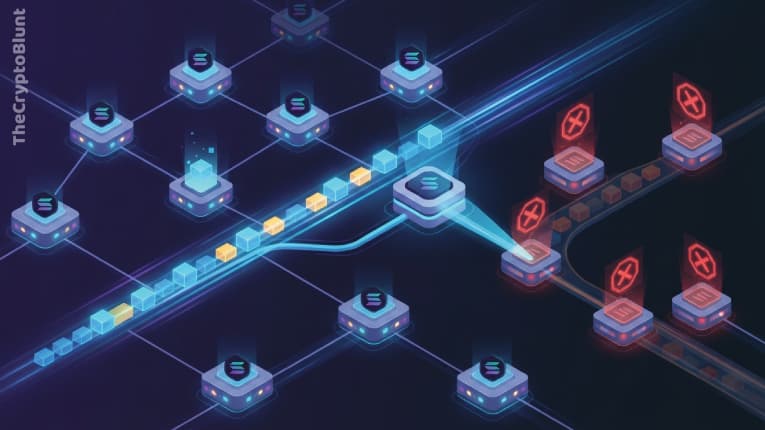
With this patch, the nodes powering Solana will no longer waste effort on transactions already discarded by the network, unlocking extra capacity that its latest speed upgrade left untouched.
Solana validators occasionally continue processing blocks that have already been rejected, a habit developers at Anza—the team maintaining the network’s primary validator client—are eager to halt.
A proposal submitted Monday to Agave, the client most Solana validators operate, would let them abandon a block the moment the network confirms a rival. Developer Philippe Laferrière’s update also streamlines an earlier concept that looked into pausing progress on competing blocks and potentially resuming it later.
Validators are the machines that handle transactions and keep a blockchain, like Solana’s, properly updated.
Occasionally, two slightly distinct versions of the same block reach the network simultaneously. Validators might begin verifying one candidate before a winner is chosen, forcing them to audit every transaction and recalculate user balances, only to discover later that their chosen version was discarded.
That becomes costly when a single block holds thousands of transactions, and if the network confirms the rival version midway through, all remaining processing is wasted.
Stay in the loop
Get crypto news before the market moves
Join thousands of investors who read our daily briefing.
No spam. Unsubscribe anytime.
Under the proposed approach, a validator would abandon the losing candidate the instant the network confirms the rival, letting its hardware pivot directly back to the valid block instead of completing work that will never be used.
The proposal arrives roughly a month after Alpenglow was activated on Solana, marking the network’s largest consensus overhaul in years and slashing transaction finalization times to about 150 milliseconds by reshaping how validators vote and reach agreement on blocks.
While Alpenglow dramatically accelerated how quickly consensus is reached on which block to include, validators still must execute every transaction and verify the outcomes—a process this proposal targets by cutting off work that lingers after the network decides.
Meanwhile, a related update is also being developed by Anza to prevent validators from stalling while waiting on the software component that arranges transactions in sequence.
Both proposals remain in active development, and Anza has yet to release figures on how frequently losing blocks are processed by validators or how much computing capacity these updates could preserve.